
A root canal that would not stop bleeding, led to a diagnosis of Acute Myeloid Leukemia (AML). Amit Arvind Shenoy narrates his experience of navigating treatment of AML, the long term side effects and why he chose to be a patient advocate.
The initial symptoms
My story begins with me biting into a peach one morning in the month of May in 2018. I was hungry after coming home from a long session of hospital audits which I performed on behalf of the Organ Donation NGO I worked for namely MOHAN Foundation.
That day my front tooth literally broke into two parts. I rushed to a dentist who reconstructed the broken tooth and told me that I would eventually need a root canal procedure to take care of the affected tooth. The procedure began and the dentist put a temporary filling in the formed cavity. I kept going to the clinic every fifteen days for over 2 months only to find that the bleeding just would not stop. The alarmed dentist told me to get my blood work done.
The AML Diagnosis
I got my CBC (Blood Hemogram) done and to my surprise found a very haywire result. My mind started analysing and after going through medical literature I got an inkling of what could be wrong with me. I told my wife that I had lymphocytosis (excess of lymphocytes – a type of white blood cells) and my haemoglobin had dropped from its normal range. When I told her about my suspicion of blood cancer, she laughed it off saying, “don’t you have better things to do in life?”
I visited a haematologist at a private hospital in Navi Mumbai. He told me to get a repeat of the CBC post three weeks. I continued going to office and carried on with my work but started experiencing bad fatigue by the end of the day.
After three weeks i.e. on 4th August 2018, I got my CBC done and took an appointment with the same doctor. This time my wife accompanied me. The doctor sat both of us down and scanned the reports. He calmly told me and my wife that I was indeed suffering from Acute Myeloid Leukaemia (AML) and that he was surprised to see me looking so normal. Generally, patients with blast crisis where blast cells are >=20%, are bedridden due to extreme fatigue. At 23% blast cells on detection I was sitting in front of the doctor during consultation before induction. My wife and I were shocked and started contemplating the various causes; to which the doctor replied, “It’s sheer bad luck.” He told me to get admitted on 13th August and that I would be out of action for another year easily. I came home, spoke to my family, and prepared them and myself for the days to come.
On 13th August 2018, I got myself admitted and at around 3 pm, my first bone marrow biopsy was performed. I was so scared of the procedure that I asked the doctor for general anaesthesia. My doctor laughed it off and gave me an anti-anxiety injection. Later in the evening, the doctor confirmed that my bone marrow had 60% blast (immature cells) and a prompt start of treatment would do me good. The samples drawn were sent for further genetic and immunological testing to ascertain the underlying cause of AML.
Treatment of AML
On 14th August, a PICC (Peripherally Inserted Central Catheter) Line was inserted into my right arm. The catheter was means of carrying the anti-cancer medication into the vein so it would get distributed throughout the body. I was shifted to an isolation ward which would be my home for the next few days.
The doctor told me that I could meet my family and friends for the next day and not after that for a long time until the treatment continued.
On 16th August, the doctor started me on my first chemotherapy – a 7+3 induction therapy wherein two drugs namely Daunorubicin and Cytarabine are given. The therapy lasted for a week.
On 30th August, 14 days after the start of the first chemotherapy, a second bone marrow biopsy was performed. In the evening, the doctor came back to tell us that to the doctor’s surprise the therapy had failed and stronger second chemotherapy namely FLAG-IDA (Fludarabine, Cytarabine (Ara-C), G-CSF (Granulocyte colony-stimulating factor) and Idarubicin) would need to be tried.
By this time, the genetic and immunological testing reports of the bone marrow came in and revealed that I was suffering from a sole 9q chromosome deletion and an intermediate-risk AML.
The second chemotherapy, the FLAG-IDA protocol as the doctor suggested is generally used for patients who have had a relapse and need stronger therapy.
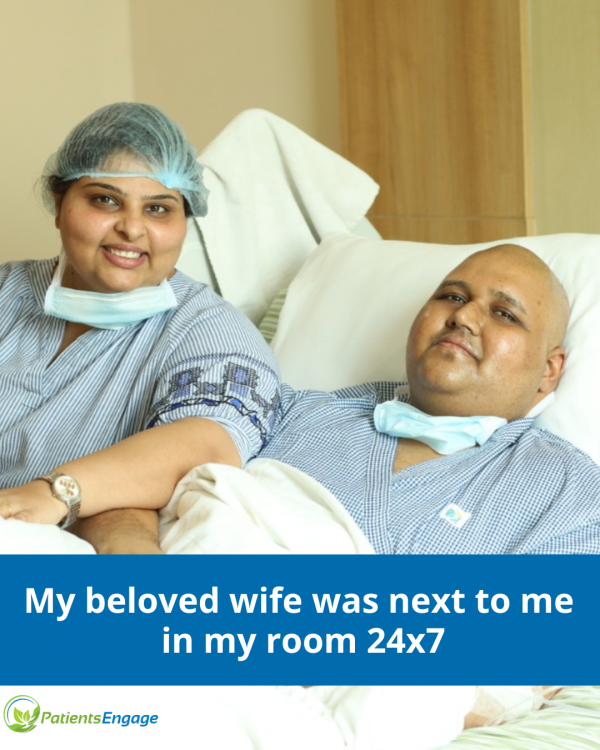
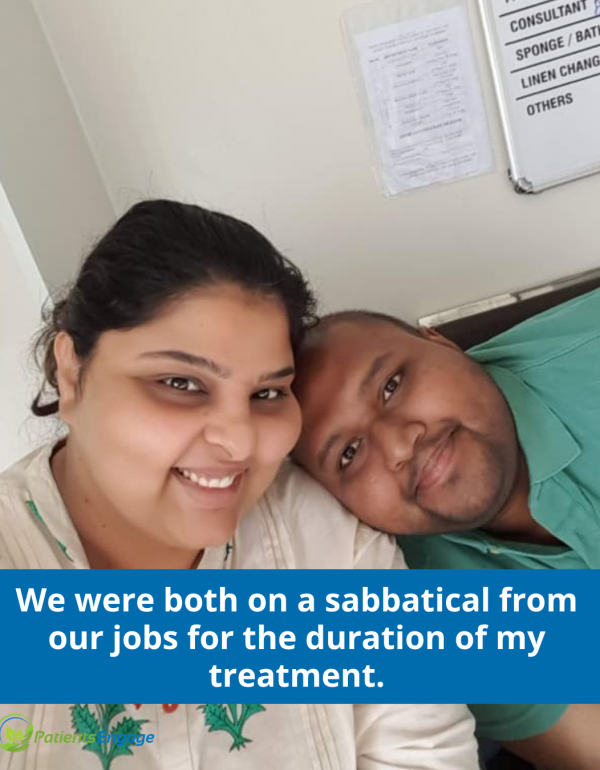
My second chemotherapy started on 5th September and lasted for 5 days. The doctors warned me that this therapy would make me weak, heavily neutropenic (low neutrophil count) and susceptible to infections. I was put on a heavy antibiotic, anti-viral, and a good anti-fungal cover to shield against any infection. I was further advised not to go alone to the toilet and that I am always to be accompanied by my wife. All this while, my beloved wife was next to me in my room 24x7. We were both on a sabbatical from our jobs for the duration of my treatment.
One night I had a bad fever spike and the body temperature rose to 104.5°F; despite the battery of prophylactic (intended to prevent disease) drugs in my body. The doctors were alarmed and decided to shift me to the ICU for further medical management. My PICC line was removed and a secondary central line inserted for a heavier battery of antibiotics post blood culturing. The next day, the doctors put a central line through my neck via the jugular vein for faster introduction of drugs and other blood products. Blood culturing results revealed that I was suffering from a life-threatening fungal infection namely Saprochaete clavata. Antifungal therapy started intravenously and I was alternatively put on oral antifungal therapy for the next 6 weeks. My stay in the ICU lasted for a week and it weakened me further.
On Day 14 post-second chemotherapy, a third bone marrow biopsy was performed. Samples were sent for genetic and immunological testing for a second time to see if any changes have occurred and to check if the therapy worked. Later that evening, came good news. The therapy had worked!
Peripheral Blood Stem Cell Transplant
Since I was an intermediate-risk AML case and had no siblings, the doctor recommended that I undergo a MUD-PBSCT (Matched Unrelated Donor – Peripheral Blood Stem Cell Transplant). Blood samples were taken for HLA matching and a search for a donor started. A day later, the doctor informed us that a search with DATRI, India’s stem cell registry had revealed 12 full-match donors for my HLA type. DATRI coordinated with the donor and scheduled a peripheral stem cell collection on 23rd November 2018.
Another bone marrow biopsy was performed on Day 21 (September 30, 2018) to reconfirm findings, and I was in remission. The genetic and immunological test reports came in and this time the genetic mutation had vanished and my bone marrow was cancer-free. I was in total cytogenetic remission.
The hospital in Navi Mumbai at that point in time was not equipped with a BMT ward, so my doctor recommended that I get the transplant done at a Pune hospital under the guidance of, a senior colleague of his. My wife drove down to Pune and met the new Hemato-oncologist who studied my case and told her to get me admitted for the allogenic stem cell transplant.
At this point, 45 days had passed, and the doctor suggested that I go home for a week. Thankfully I was covered by medical insurance and post a good discount from the hospital management, I came home on 30th September 2018.
The doctor told me to get readmitted on 7th October 2018 for a third protective dosage of chemotherapy before my stem cell transplant. The hospital gave us an estimate of 40 Lakhs plus for the transplant including post-transplant care. At this point in time, we had almost exhausted all our savings.
My wife’s uncle recommended that we try out crowdfunding to raise funds. My wife floated a campaign for me on 10th October 2018, and spread the message of the campaign via social media and by word of mouth. To our surprise, we raised 45 Lacs in a span of just 5 days. People donated selflessly and we are grateful to them for their generosity to the cause.
I underwent my 3rd round of chemo – a HIDAC Cytarabine cycle from 7 to 12th October 2018. After chemo, I contracted an infection which prolonged my stay in the hospital till 15 November 2018.
Finally, I was back home in preparation for the journey ahead – My Stem Cell Transplant.
After a good uneventful 15 days, we shifted to Pune which would be my home for the months to come post-transplant.
On 6th December 2018, I got admitted to the hospital where a new PICC line was inserted in preparation for the final chemo pre-transplant.
I was part of the CIBMTR RIC (Reduced intensity conditioning) trial procedure using Melphalan and Fludarabine followed by full body irradiation meant to wipe-out my white blood cells. With Melphalan, came mucositis which is ulceration inside the mouth despite having ice chips during the entire infusion. I vomited blood the next day as one of the ulcers ruptured – a first for me. I was infused with a battery of drugs to prevent organ damage after this heavy chemo.
Come 13th December 2018, the day of my bone marrow transplant, I was taken to the ICU and there it was; freeze-thawed stem cells from my donor (who I am ever grateful to) sitting in a sterile tray draped in green sterile cloth. The entire process took 3 hours for the stem cells to be put inside my body via a simple blood transfusion.
Five days later, I had Grade 3 GVHD (Graft vs Host Disease) with severe diarrhoea and poor appetite. To diagnose the extent of GVHD, I was made to undergo a colonoscopy. The preparation for this procedure involves drinking 2 litres of PEG Electrolyte solution to clear the colon. Colonoscopy went well and that was a huge relief.
A day later, I was down with an infection accompanied by high fever. I experienced troubled breathing as my SpO2 dropped to 90%, I was immediately shifted to the ICU where upon investigation it came to light that my neutrophil count was zero. I was battling for my life. My wife was told that the neutrophils might improve in a day or two but in the meanwhile to start looking for neutrophil donors. If the neutrophil does not improve after a donation, then it means the body is in acute rejection of the transplant. I was started on IV methylprednisolone to prevent acute rejection and the therapy worked wonders. Later, a chimerism test revealed a 99.77% donor stem cells and 0.23% of my own cells which meant the transplant was a success.
I still could not eat as my mouth had ulcers, so I was started on an IV TPN (Total Parenteral Nutrition). Eventually, I could start eating 15 days later.
After a 43-day-stay at the hospital, I got discharged from the hospital and was made to undergo a 15-day antiviral IV regimen to prevent the occurrence of Cytomegalovirus (CMV).
I underwent quarterly blood tests to ensure that the CBC was on track post-transplant and finally waited for 6 months more for my blood group to stabilize to new Blood Type B+. I was O+ before my treatment and stem cell transplant. My donor who was full HLA mismatch and B+, his blood group took over after the transplant (donor-recipient cell chimerism).
At the end of an 8-month stay in Pune, I bid goodbye to my Hemato-oncologist and shifted to my hometown, Mumbai.
Since then, it’s been an uneventful 7 years and 4 months. I now have a small kid and look forward to live to cherish happy memories with him in the years ahead.
Long Term Side Effects
Speaking of long-term side effects, I have diabetes and have developed chemo-induced peripheral neuropathy (after FLAG-IDA protocol). The neuropathy gave me trophic ulcers on my foot soles which limited my walking and took a long time to heal. I am now on anti-diabetic medication and pain medication to control my neuropathy pain. Two years later, the ulcers got infected and I had to be surgically operated upon to remove infected ulcers. I couldn't walk or stand in one place for long but now after the minor surgery on the right sole in Jan 2026, I am much better.
Diabetes (long term side effect) also slowed the healing. Neuropathy is very controlled due to pain medicines and methyl cyanocobalamin. For my diabetes, have totally given up added sugars. Fruit intake is one fruit a day (apple, pear, papaya, orange). Stevia in tea or coffee. Life goes on! What matters is being positive.
My journey into Patient Advocacy
Cancer transformed my life, giving me a fresh sense of purpose.
After fighting acute myeloid leukemia, enduring chemotherapy, facing life-threatening infections, undergoing a stem cell transplant, and dealing with graft-versus-host disease, as well as living with the long-term effects of treatment, I understand the physical, emotional, and financial challenges that patients and their families go through.
I decided to become a patient advocate because I believe sharing my story can bring comfort, guidance, and inspiration to others.
Through advocacy, I aim to raise awareness about blood cancers and stem cell donation, assist patients in making informed decisions, and remind them that hope never disappears, even during the toughest times.
Surviving AML was my second chance at life, and patient advocacy is my way of honoring that opportunity and helping others find courage in their own journeys.