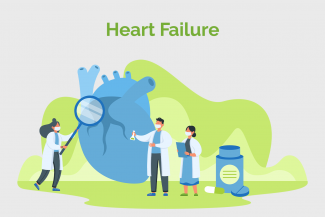
  • Heart Failure
    Heart Failure is a commonly seen condition amongst our aging population. In spite of advanced therapeutic science, incidence rates continue to increase. Life expectancy of patients with Heart Failure can be improved with lifestyle changes and compliance with their treatment plan. Mumbai-based cardiologist, Dr Nihar Mehta explains Heart Failure comprehensively.
Submitted by PatientsEngage on 11 December 2021
Heart Failure Types

What is ejection fraction (EF)? Why is it important to know your EF number and what it means?

Ejection fraction refers to the Pumping Power of your heart. It is normally 55-60%. It is important to know what is the pumping power of your heart since reduced pumping power or ejection fraction implies that your heart is diseased and increases the risk for congestive heart failure.

Are there different types of heart failure?

Heart failure most often occurs due to reduced ejection fraction – called HFrEF (heart failure with a reduced ejection fraction) or Systolic heart failure where the pumping power of the heart is weak and the heart fails to contract well enough to pump blood to all the organs. This type accounts for 75-80% of patients with heart failure. The common causes for this type of heart failure are Heart attacks or blockages in the heart (coronary) arteries or cardiomyopathy (weakness of the heart muscle).

The less common type of heart failure is called Heart Failure with a preserved Ejection Fraction (HFpEF) or Diastolic heart failure where the heart’s pumping power is preserved but the heart fails to relax adequately. Adequate blood does not enter the left side of the heart leading to build up of pressure and congestion in the lung. This is also called Diastolic heart failure. It can be seen in patients with heart valve diseases, heart beat abnormalities (arrhythmias), high blood pressure, diabetes mellitus, renal failure, thyroid disease, anemia amongst several other causes.

Changed
16/Mar/2025
Condition

Stories

  • Stock pic of a Cardiac Pacemaker with text overlay on blue strip Cardiac Pacemaker FAQ
    Cardiac Pacemaker - Frequently Asked Questions
    More than 1 million million permanent pacemakers (PPMs) are implanted worldwide annually. Around 100,000 devices are implanted annually in Germany, and only over 20,000 in India. PatientsEngage team answers the frequently asked questions on Pacemakers so people can make informed decisions. What is a pacemaker? A pacemaker is a small device used to correct our heart rate when it is slower than the normal heart rate (known as bradycardia). It is implanted through a surgery in the chest or abdomen…
  • Picture of a young woman in a green dress and text toverlay Navigating Pulmonary Arterial Hypertension and Lung Transplant
    Staying Strong through Pulmonary Arterial Hypertension and Lung Transplant
    Karthika Ramachandran narrates her story of pain of living with Pulmonary Arterial Hypertension (PAH), and the strength and resilience that helped her manage the whole process of PAH treatment and lung transplant recovery. What started as a habit of journaling her daily experiences eventually inspired her to turn those reflections into a book.  Please tell us about your conditions and when you were diagnosed. I am a 33 year old single mother and a Logistics Officer in Dubai, born and…
  • Picture of a young woman with the text overlay: living with an invisible illness | Pulmonary Hypertension
    Living With A Rare Form Of Pulmonary Hypertension
    Runjhun Hajarnis, 34, suffers from PVOD, a largely invisible illness which is a variant of Pulmonary Hypertension, which, in turn, prevents her from living life as normally as she would want to. As she says: "No one knows just by looking at you how sick you are". Please tell us about your present condition. Can you describe it? I suffer from Pulmonary Veno Occlusive Disease (PVOD), a form of Pulmonary Arterial Hypertension. In this disease, the small blood vessels in the lungs become…
  • Stock image of woman with swelling in legs and an inset image of swelling in feet. Overlay of blue strip  with the text Is Leg Swelling Dangerous
    पैर में सूजन: डॉक्टर को कब दिखाएं
    हममें से कई लोगों ने पैरों में भारीपन का अनुभव किया है जो असहज महसूस होता है। कुछ मामलों में यह सामान्य होता है और अपने आप ठीक हो जाता है लेकिन अन्य मामलों में, यह स्वास्थ्य से संबंधित एक खतरनाक संकेत हो सकता है। यह लेख तीन मुख्य विषयों पर केंद्रित है: पैरों में सूजन का कारण क्या है, इसके बारे में कब चिंतित होना चाहिए और इस के लिए स्वास्थ्य सेवा पेशेवर से कब मिलना चाहिए। पैरों में सूजन निचले अंगों के ऊतकों में अतिरिक्त द्रव प्रतिधारण के कारण होती है। यह द्रव सामान्य रूप से परिसंचरण तंत्र (…
  • Stock image of woman with swelling in legs and an inset image of swelling in feet. Overlay of blue strip  with the text Is Leg Swelling Dangerous
    Leg Swelling: When To See A Doctor
    Many of us have experienced heaviness in legs that feels uncomfortable. In some cases, it is normal and goes off on its own but in other cases, it could be an alarming sign for the body. This article focuses on three main features: what causes swelling in the legs, when to be concerned about it, and when to visit a healthcare professional. Leg swelling is caused by excess fluid retention in the tissues of the lower limbs. This fluid would normally be in the circulatory system but squeezes out…
  • Female physiotherapist helping an older man with weight training and the text overlay Importance of Cardiac Rehabilitation
    Cardiac Rehabilitation for Heart Failure
    Heart Failure is a life changing condition that is chronic and progressive. Cardiac Rehabilitation is known to be one of the best tools to enhance functioning and well being while improving quality of life. Prof Jaimala Shetye, an experienced Physiotherapist with 39 years of Physiotherapy teaching and clinical experience explains the role of Cardiac rehabilitation in patients with Heart Failure.  What does cardiac rehabilitation mean? Cardiac Rehabilitation is a coordinated multifaceted…
  • A woman with a rare heart disease ATTR-CM in a red dress with her husband in a white dress
    My Wife Has A Rare Heart Disease
    Mrs. Khairunnisha Usmanhaji Patel is a 58 year old woman with a rare heart disease ATTR-CM. Her husband Usman Patel speaks about the her early symptoms, the years it took to get a diagnosis, how her condition affects her quality of life and how she is coping. What condition does your wife have? My wife has a rare heart disease called ATTR-CM (Transthyretin amyloid cardiomyopathy). Can you recall the first symptoms you noticed for which you connected with the doctor? How did the diagnosis come…
  • Profile pic of Dr. PD Rath and the text Heart Conditions Scleroderma and the logos of PatientsEngage and Scleroderma India
    Scleroderma and Heart Conditions Management
    Dr Prasan Deep Rath, is the Senior Director & Head – Rheumatology at Max Super Speciality Hospital in Saket, New Delhi. He talks about how the heart is a major organ involved in Scleroderma at the Sclerocon e-conference held in June 2023. He details the layers of the heart for better understanding, the connect with lungs and how to recognise the differences between right and left heart failure. In addition, he explains how Scleroderma can affect the heart and how we can detect it on time.…
  • Vibha in a dress with a blue strip and the text Learn and Be Proactive
    Learning To Live and Love With A Chronic Illness
    Vibha Gupta, 49 originally from Delhi and now in Chicago, USA, lives with multiple chronic illnesses like Sjogren's and heart failure. She shares her journey of learning about her illness, the lifestyle changes that help her cope and why she thinks being proactive is important. Please tell us about your conditions and when you were diagnosed. I have Heart Failure, Sjogren’s, Raynaud’s and recently Idiopathic Pulmonary Arterial Hypertension (PAH). I was diagnosed in: 2010 - Raynaud’s 2013 –…
  • A man wearing a hat ready to travel with text overlay on blue strip Heart Failure: Travel Tips
    Travel Tips For Persons With Heart Failure
    People living with Heart Failure (HF) are more likely to suffer from sudden cardiovascular events especially during travel. But with a little planning, it is possible for persons living with heart failure to travel.  Here are travel recommendations to ease the anxiety and reduce the risk of adversities for all patients with HF. Consult your Cardiologist for a health and travel assessment at least 4-6 weeks before date of travel Before selecting the travel destination, factor in the…