
Rachana Vijan is a 66 year old breast cancer and heart failure survivor who chose to smile through it all. Here she shares her journey starting from early symptoms to the shocking diagnosis of heart failure and learning to proactively manage the condition and its complications.
What were the early symptoms of heart failure? What made you go to a doctor?
Life tested me with not one but two very serious health battles. In 2018, I was diagnosed with left breast cancer. It was one of the most difficult phases of my life, but with chemotherapy, surgery, radiation, and a very determined mind, I came through it.
To talk about my Heart Failure condition.
Initially, my symptoms were subtle. In 2019, during a routine office check-up, my pulse was high at 125, but I dismissed it as I had just climbed the stairs. Later, while shopping for my son’s wedding, I suddenly felt dizzy and unable to stand. I ignored it as "shopping exhaustion”. After that, I experienced progressive breathlessness, particularly while lying down.
Then, in August 2020 (during COVID), I started feeling a little breathless while talking, and worse could not lie down straight on my back. As soon as I lay down, I felt as if someone was sitting on my chest and suffocating me. I would immediately get up and sit upright! After a couple of days this same dreaded feeling of someone sitting on my chest and suffocating me came when I was lying down on my sides. I just could not lie down. No way. I started spending my time sitting. But how long can one sit? And how do I sleep? To avoid getting hurt, I started piling pillows on my side of the bed so if I fell asleep sitting, and fell, it would be on the cushions. This did not help much as I was so conscious of falling, I could not sleep.
My family tried all kinds of tricks to help me sleep, my daughter-in-law tried to lull me into sleeping like a mother would to her infant, but I could not. I started sitting with pillows on my lap and feet on the ground, but a little nap here and there was all I could manage. At the time, I firmly believed this was due to me being stuck at home and getting claustrophobic due to the pandemic. We went to a local doctor, who gave some pills, but to no avail.
After about 20 days, I told my family to take me to the hospital, as I could not bear it any longer. Leaving my husband at home, as we did not want to take the risk with COVID infection; my son and daughter-in-law rushed me to the Kokilaben Dhirubhai Ambani Hospital. On reaching the hospital, they transferred me to a wheelchair, and I started heaving and gasping for air. I was immediately rushed to the Emergency room. My medical Oncologist was informed, and some tests were conducted including an ECG.
What tests were done? How did the diagnosis come about?
Once I reached the Emergency, they immediately did an ECG, This was followed by blood pressure and pulse monitoring, thyroid tests, and a 2D Echo.
I suffered from pleural and pericardial effusion. In simple words, water retention in my lungs, the left much more than the right one. The doctor had to transfer me to the ICU. In addition, I had to do my Chest X-Rays, Ultrasound (A +P), Mammography, Battery of Blood tests. Believe me, I was going through my days in the hospital like a robot.
My ECG was abnormal, blood pressure dangerously low, and heart function catastrophically reduced. The 2D Echo confirmed severely reduced heart function. My thyroid was also elevated, and potassium levels were dangerously high. These tests collectively led to the diagnosis of heart failure, which is where the heart cannot pump blood as efficiently as it should.
The diagnosis truly hit me emotionally when I saw the words “Heart Failure” outside the OPD.
What was your reaction to the diagnosis? How and when did you break it to your family?
During my breast cancer diagnosis, I was shattered. I cried and cried. For some time, it truly felt as if the world had come to an end. My first thoughts were not even about myself, but about my husband and son. I first told my husband when the tests were advised, and once the biopsy confirmed it, the family came to know. My son took it the hardest.
With the heart failure diagnosis, the real emotional blow came when I saw the department board. Reading the words “Heart Failure” made everything suddenly very real. It hit me like a hammer. I had just started feeling normal and happy to have conquered cancer and now this! An LVEF (Left Ventricular Ejection Fraction) of 15% made my heart sink further. It felt like the dreaded writing on the wall. My son broke the news gently to my husband. My family was anxious but ready to take on the challenge together.
What was the treatment prescribed?
The treatment involved strict lifestyle modifications, careful medication management, daily physio exercises, and constant monitoring of blood pressure, pulse, and ECGs. Regular hospital visits and tests were mandatory, and I was advised to rush to the hospital if I felt dizzy or fuzzy.
Were there any complications from the primary condition?
Yes, there were quite a few. With heart failure, the biggest complications were severe breathlessness, dangerously poor heart function, very low blood pressure, thyroid imbalance (very high TSH), and later high potassium levels which forced us to further restrict my diet. At one stage, a pacemaker was considered, but my parameters were not suitable.
During my hospitalization, my potassium levels became dangerously high, and I had episodes of extreme breathlessness requiring ICU care. Sleep deprivation and anxiety were also major challenges. Even today, standing for long or climbing stairs can trouble me. My Legs pain a lot and I need to sit down. I also lose my balance.
Have you tried complementary medicine or therapies, like homeopathy or ayurveda? If yes, did it help?
I did not try any alternative systems of medicine. My complete faith was in my doctors and the treatment they advised.
What medications are you currently on?
After my recovery, I am currently on beta blockers and anti-diabetic medication even though I am not diabetic. Medicines include Calcium tablets daily, denosumab injection every 6 months for osteoporosis, and gabapentin for neuropathic pain.
Were there any side-effects of the medicines? If yes, how do you manage them?
The treatment side effects were very real. Due to the no-salt diet, my sodium levels had to be monitored regularly. They could not drop beyond a point, to avoid complications related to low sodium. That was one big worry. In addition, my potassium levels were very high due to the medications, for which I had to restrict my diet to no-potassium food options. I ate very cautiously. To normalise the high potassium I had to take further medication. My BP would go down to dangerous levels, as low as 70-50. I had to monitor my BP twice a day and in between if I felt sudden weakness.
What kind of specialists do you consult and how often?
I consult my cardiologist regularly, initially every three days, with ongoing monitoring via ECG and 2D Echo, but now that my heart function is within medically acceptable range. It rose from 15% to 55%. I have to go for annual tests and visits. I also perform daily physiotherapy exercises as advised. I also have to annually visit my Surgical Oncologist, my Gastroenterologist for my fatty Liver (thankfully the fatty liver has been reversed now, and my Orthopaedic for my Osteoporosis. All the doctors are at the same hospital.
Do you have a family history of this condition? Is it an inherited disorder? Was genetic testing done?
No, I do not have a family history of this condition. No genetic testing was done.
Did you make any corelation between breast cancer treatment and your Heart Failure condition?
Yes I did make the correlation. Especially the radiation oncologist did tell me that radiation affects the heart but takes at least 10 years. Also other than than the heart function being affected, I did not have any blockages, or high cholesterol which could indicate that I had some previous problem.
What changes have you made to your lifestyle because of this condition?
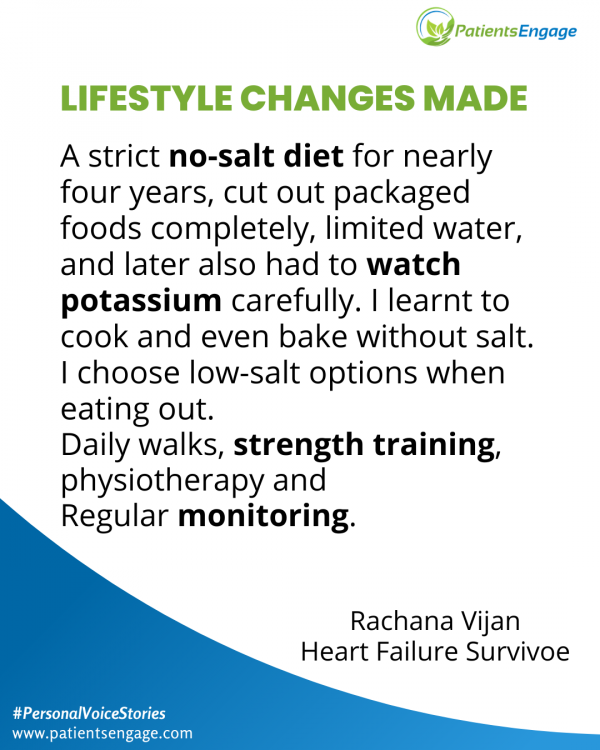
The heart condition changed my lifestyle dramatically. I stayed on a strict no-salt diet for nearly four years, cut out packaged foods completely, limited water, and later also had to watch potassium carefully. I learnt to cook and even bake without salt. Then came the doctor approved cheat days, but I’ve continued my no-salt diet at home and choosing low-salt options when eating out. Alongside that came daily walks, strength training, physiotherapy, and regular monitoring.
How did you mentally/emotionally cope with it all?
For me, the mind was half the battle. I made a conscious decision not to drown in self-pity. Keeping a positive attitude, smiling, and focusing on what I could control helped immensely. My family’s constant presence was critical.
I smiled, dressed up, wore my lipstick, matched my jewellery, and went to the office. I sang, laughed, played games with family after doctor/hospital visits and sessions, and surrounded myself with happy people.
At the same time, I also learnt it was important to let my emotions out. There were moments when I cried in private, in the bathroom or alone in my room, just to release the heaviness. The hardest moments were hearing the diagnosis, reading the words heart failure, and those endless nights when I simply could not lie down and sleep.
Did you see a counsellor for support? Were you offered counselling by your doctor?
I did not take formal counselling. My doctors, my family, my friends, and my own “never give up” mindset became my support system.
How has your family supported you?
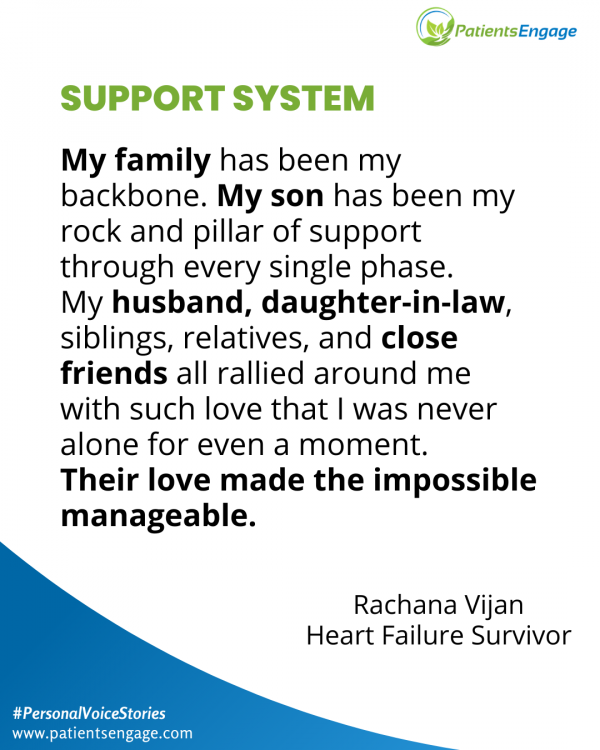
My family has been my backbone. My son, above all, has been my rock and pillar of support through every single phase. He has held my hand and comforted me when anxiety rose, through hospital visits, sleepless nights, surgery, chemo, and heart recovery. My husband, daughter-in-law, siblings, relatives, and even close friends all rallied around me with such love that I was never alone for even a moment. Their love made the impossible manageable.
When did you break the news to your friends and distant relatives? How did they take it?
I do not remember the exact timeline. My friends and extended family came to know during the treatment process. They were incredibly supportive, sending me no-salt delicacies, hospital visits, staying overnight, or simply sitting with me and making me laugh.
Did you inform your workplace? If yes, how did they handle it?
Yes, and I was blessed with a very supportive workplace during my tryst with Cancer. My seniors and colleagues treated me normally, which I truly appreciated. They helped create a positive environment and supported me in ways that made it possible for me to continue working through treatment. During my Heart Failure episode, COVID was in full swing so it was work from home. After diagnoses they ensured I worked a few hours only.
What were some of the challenges you faced?
The biggest challenges were the emotional shock of the diagnosis, the breathlessness, adhering to the strict food and water restrictions, managing the daily potassium and sodium levels, and above all the constant effort to stay mentally strong. Some days the challenge was simply getting out of bed and choosing to keep going. The fear of complications and hospitalization was always present, especially during the early days.
What is your present condition?
Today, I am happy to say that I lead a full life. I go for walks, do yoga, go to the Gym and under a trainer do strength training and cardio exercises. I meet friends regularly, call relatives and friends home for lunch/dinner, go for kitty parties, write blogs, and enjoy my meals, still mostly without salt. I continue to live with gratitude and joy. I have also trained to be a Patient Advocate with PatientsEngage, and with their guidance I am now contributing to the NCG Guidelines.
I still get intermittent sleep. I try to take power naps whenever my body demands it. I laugh and joke to allay my anxiety. I do not stand for long. I search for a place to sit down (it could be a curb if there is no place or I call for a chair. Many a times I carry my portable table)
What is your advice to patients who face similar challenges?
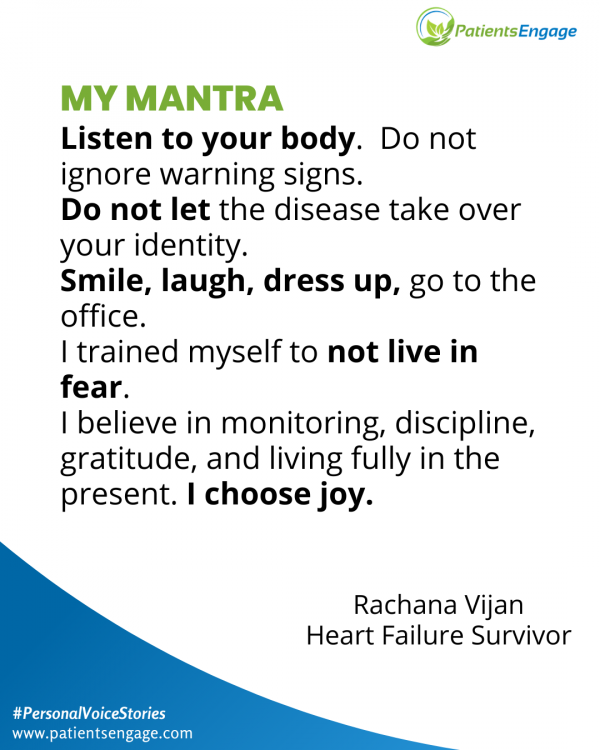
Please listen to your body. It always whispers before it screams. Do not ignore warning signs. Trust your doctors completely, follow their advice to the letter, stay disciplined, eat for strength, and do not let the disease take over your identity. Smile, laugh, dress up, go to the office. If you can, stay around people who lift your spirits, and remember this is just a phase, it can be managed. This too shall pass.
What are you worried about for the future?
Initially, I always felt the Sword of Damocles hanging over me. However over time, I have trained myself not to live in fear of the future. Fear does hover over me, but I do not allow it to creep in and capture me. Worry steals today’s peace, and after all that I have overcome, I believe in monitoring, discipline, gratitude, and living fully in the present. I choose joy.