
Anushree Risbood, 41 from Pune was diagnosed with Relapsing Remitting Multiple Sclerosis, and her life has not been the same since. She shares the details of her journey and how it has changed her perspective.
Please tell us about your present condition. Can you describe it?
I live with Multiple Sclerosis (MS). Currently I am on a wheelchair, facing tremendous imbalance and spasm issues.
What were the early symptoms? What made you go to a doctor?
There were several issues I was facing before I was actually diagnosed with MS. Imbalance, loss of grip, heaviness in lower body.
Is there a history of any kind of MS related condition in your family?
No, nobody in my family faced anything like this before.
When and how were you diagnosed? What tests were done? How did the diagnosis come about?
I was mis-diagnosed initially, because the doctor I went to then thought it was only weakness, and nothing more. But I was diagnosed correctly in November 2014 with Multiple Sclerosis. I was asked to do an MRI by a doctor who knew instantly what was wrong with me. I was admitted to the ICU because I had lost my vision, my ability to swallow and I couldn’t walk. By the time I was diagnosed correctly I had also lost my ability to speak, the grip in my hands had loosened, and I suffered from a loss of bladder control.
What was your reaction to the diagnosis? How and when did you break it to your family?
Initially I was confused, as was my family because we had never heard of Multiple Sclerosis.
Related Reading: What is Multiple Sclerosis
What happened next? (specialist referral, course of treatment etc.)
I was put on heavy doses of steroids, and felt absolutely fine then, clueless that this was going to come back. Ultimately I was diagnosed with RRMS i.e Relapsing Remitting Multiple Sclerosis.
Did you have any other pre-existing health conditions?
No
What medications are you on? Pls mention all allopathic medicines and indications of each.
Currently I am taking Baclofen 10 mg, a skeletal muscle relaxant used to treat muscle spasms, stiffness, and cramping caused by multiple sclerosis, spinal cord injuries, or diseases. It acts on the central nervous system to improve muscle movement and relieve pain, commonly prescribed for chronic spasticity. I have recently had an MRI, so my treatment might change, depending on the report.
Were there any side-effects of the medicines? If yes, how do you manage them?
When I was on steroids I faced extreme weight gain and hormonal imbalance. With Baclofen, I am not facing any side effects as such.
What is your treatment pattern? Besides medication, what else do you do to heal and improve quality of life (diet, nutrition, exercise)?
No pattern as such, I face each day as it comes. I follow physiotherapy religiously.
Have you had to make some changes to your lifestyle because of your condition?
Not successfully but I try to avoid Stress. Avoiding stress is difficult all the time, but I manage it. I do meditation, breath work, yog nidra and all these help. I also listen to nature sounds on YouTube. It helps me relax. I also follow a diet of simple homemade food. I eat everything, but in moderation.
Do you face any complications from the treatment of your condition? Has it triggered any other health condition? If so, how do you handle it?
Not yet.
What are your main challenges and what is your advice to patients who face similar challenges?
My main challenges at the moment are imbalance, spasms, fatigue and a loss of bladder control. I would suggest to everyone with the condition to follow physiotherapy daily and also focus on mental health.
What do you do to preserve your mental health?
I practice Meditation. Meditation takes time and a lot of practice, but starts working wonders after sometime. I try to spend time amidst nature, and since I’m a religious person, I also chant.
What kind of specialists do you consult (including Physio/ Occupational therapist/ Psychiatrist etc.) and how often?
I consult a Neurologist and a physiotherapist. Neurologist once in 3 months, and a physiotherapist 4 times a week.
Did you have to travel outside your city for medical treatment?
No
Have you tried alternative medicines or therapies, like avurveda, homeopathy, siddha?
Yes, I did try homeopathy almost 12 years ago, but I did not get any positive results.
Has it been difficult emotionally to cope with your condition?
Yes. Acceptance is the hardest
Has your family supported you?
Yes.
Anything that you would like to share with our readers and the MS community.
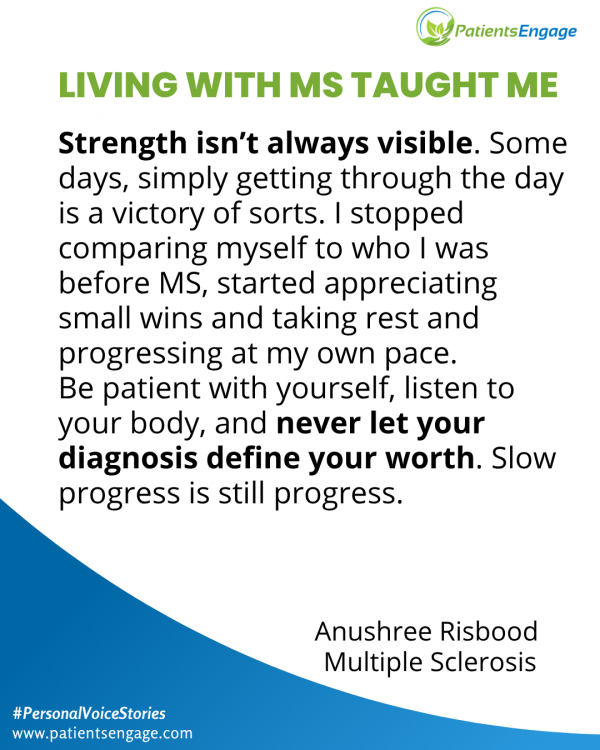
Living with Multiple Sclerosis taught me that strength isn’t always visible. Some days, simply getting through the day is a victory of sorts. I stopped comparing myself to who I was before MS and started appreciating small wins, started taking rest and progressing at my own pace.
My advice: be patient with yourself, listen to your body, and never let your diagnosis define your worth. Slow progress is still progress
What are you worried about for the future?
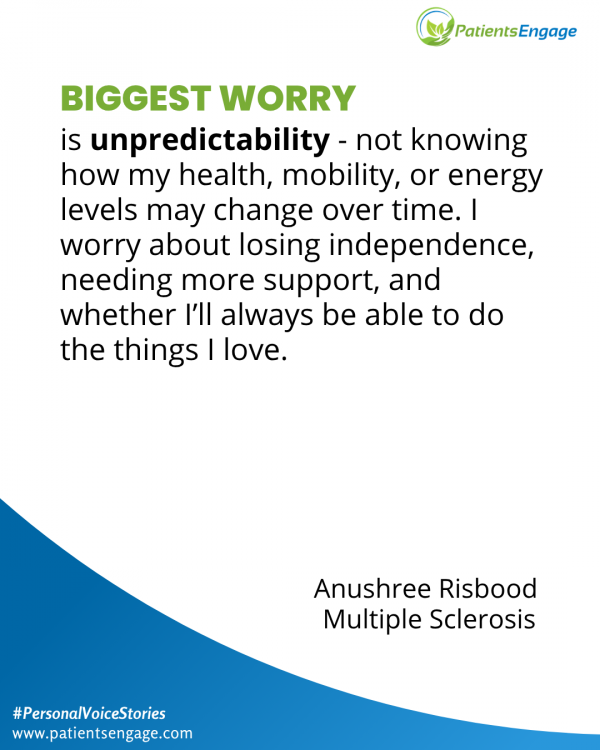
Loneliness. As someone living with Multiple Sclerosis, one of my biggest worries about the future is unpredictability — not knowing how my health, mobility, or energy levels may change over time. I worry about losing independence, needing more support, and whether I’ll always be able to do the things I love. But at the same time, living with MS has also taught me to focus more on the present, adapt when needed, and appreciate every small moment of strength and normalcy.