

Shefali*, 55 from Mumbai has lived with Relapsing-Remitting Multiple Sclerosis for 17 years. She shares her journey from diagnosis of MS to treatment and management, how she re-learnt basic skills in order to function effectively.
Please tell us a bit about your condition. Can you describe it?
I am a person living with Relapsing-Remitting Multiple Sclerosis (RRMS) for the last 17+ years. I was diagnosed in April 2009. I am in good functional condition with a thriving career. I actively volunteer with MSSI (Multiple Sclerosis Society of India).
What were the early symptoms? What made you go to a doctor?
My first symptom on day 1 was blurred vision / double vision (diplopia), and feeling weak. I thought I had low blood pressure. Second day, I started losing balance. Third day things started getting worse with vision and balance further worsening. Fourth morning I realized I could see with one eye each but not with both the eyes and understood that my optic nerve was not functioning and I went to an ophthalmologist asking him to examine me and suggest if he would treat me or I should see a Neurologist. On the fifth day, I was totally bedridden with no ability to move, speech impairment and language impairment. I was hospitalized, MRI was done and then started on standard steroid treatment to control the attack. This was further followed by various other tests.
What tests were done? How did the diagnosis come about?
BERA (Brainstem Evoked Response Audiometry) test, MRI, cerebrospinal fluid test, and other blood work. These were prescribed by the neurologist and done in Mumbai.
What was your reaction to the diagnosis How and when? did you break it to your family?
The diagnosis was given to my family, since I was not in a condition to understand anything. My reaction was normal because I am a person who does not really get concerned about situations. I just believe that whatever situation comes, we have to just find a solution, so I knew I would come out of it.
What happened next? (specialist referral, course of treatment etc.)
I was referred to a neurologist who did all the above tests. They put me on steroids to curtail the MS attack, and of course, after that, other symptomatic medicines were started.
Have you tried complementary medicine or therapies, like homeopathy or ayurveda? If yes, did it help?
No, I did not because I did not want to experiment on myself.
What medications are currently on? Were there any side-effects of the medicines?
After I started on steroids, my sugars went up and diabetes set in. There were other things that happened, like there was very bad constipation.
After few months, when I had a relapse, I was started on Disease Modifying Therapy (DMT). Initially, for four years, I was on interferon beta 1A. However my liver started getting impacted, we stopped, and then we tried beta serum 1B. After a month, my liver function improved slightly. The same time, Dimethyl Fumarate, was made available in India in the form of tablets. I was started on Dimethyl Fumarate but I could hardly tolerate this for a couple of weeks. Since 2015, I'm not on any DMT. Primarily I am just being treated for my diabetes, any periodic symptoms and taking supplements like calcium, B12, vitamin E, etc.
What kind of specialists (including Physio/ Occupational therapist/ Psychiatrist etc.) do you consult and how often?
I usually only see my neurologists and diabetologist. I do not see anybody else today. Initially, I had a physiotherapist who came every day, but for the last ten plus years I do my exercises by myself. This includes legs and arms strengthening exercises, pranayam, balancing exercises and I try to do as much physical activities as possible so that my body muscles are active.
Did you have to travel outside your city for medical treatment or consult?
In 2012, my then neurologist had referred me for a second opinion in New Delhi to another neurologist who has an interest in MS, but nothing changed. My treatment remained the same.
Do you have a family history of this condition? Is it an inherited disorder? Was genetic testing done?
There has been no family history.
What changes have you made to your lifestyles because of this condition?
The most important thing for me to manage my condition is to stay away from any kind of situation that could give me an infection. So I make sure that I take care of what I eat and where I go. Similarly, I make sure that I do not expose myself to a lot of heat. I live a very healthy lifestyle. I make sure that eat only what my body requires. Until now, I have made sure that my weight remains in check in order to ensure I do not get any more health conditions. Barring these, I live a very healthy lifestyle. I'm a working professional who has to travel extensively. In all, MS doesn't bother me and have never hindered me. Even when I travel globally, I take care of myself appropriately.
How did you mentally/emotionally cope with it all? Pls mention any specific times and issues that were difficult.
First of all, I did not make a monster of in my head. I just said, "OK, there is something that has happened to me, and I have to come out of it." My son, was in 9th grade when I got MS. So naturally he was my motivation to get out of this whole thing quickly. I did not believe that MS was going to slow me down or really impact me as much as the internet showed. I strictly kept away from those who tried to scare me or demotivate me. I think my staying positive and my focus on getting over MS really helped me to get out of it. Sometimes I had difficulties that I had to deal with by myself. Eg. mood swings, annoyance, irritation and anxiety where I promptly took help of my doctor, who referred me to a psychiatrist who helped me deal with these.
Did you see a counselor for support? Were you offered counseling by your doctor?
No, I did not have to see a counselor, nor did my doctor counsel me. I looked it up myself as to what I was going through, and I found and devised my own ways to deal with it. In fact, I had to counsel my family about my condition and give them hope!
How has your family supported you? Who has been your biggest support/companion through it all?
My family and few of my office colleagues were my best support. My son and sister were my backbone at home. At work, my CEO made sure my work was taken care off and I had all the peace to recover and also rehabilitate. One of team members who was my next in line supported me a lot.
When did you break the news to your friends and distant relatives? How did they take it?
I didn’t have to break the news. It was not necessary for me to hide anything. All those who knew I had fallen sick, knew I was diagnosed with MS. Many just understood that something went wrong with my eyes.
Did you inform your workplace? If yes, how did they handle it?
Like I mentioned above, my CEO whom I reported to and my next in line knew of MS and had seen a person with MS themselves. One of my colleagues was a doctor and knew of it. So it was dealt with empathetically. Even when I resumed work after 3.5 months, accommodations were made for me at work.
What were some of the challenges you faced?
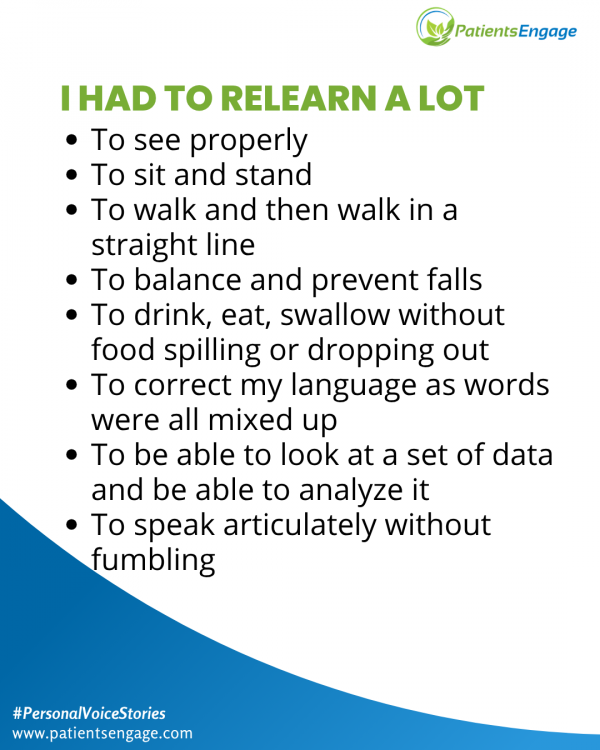
I had to relearn a lot of things eg. -
- To see properly
- To sit
- To stand
- To walk and then walk in a straight line
- To balance and prevent falls by making sure my legs have strength through physio exercises
- To drink, eat, swallow without food spilling or dropping out of my mouth
- To correct my language as words were all mixed up
- To be able to look at a set of data and make meaning out of it, to be able to analyze and predict reasonably
- To speak articulately without fumbling
I devised exercises for myself based on my knowledge and understanding of human anatomy, cognition, human brain’s functioning and brain’s development, capacity and capability. I became more aware of myself to help myself better.
What is your present condition?
I am a fully functional, independent person living a highly active normal life albeit with guardrails.
What is your advice to patients who face similar challenges?
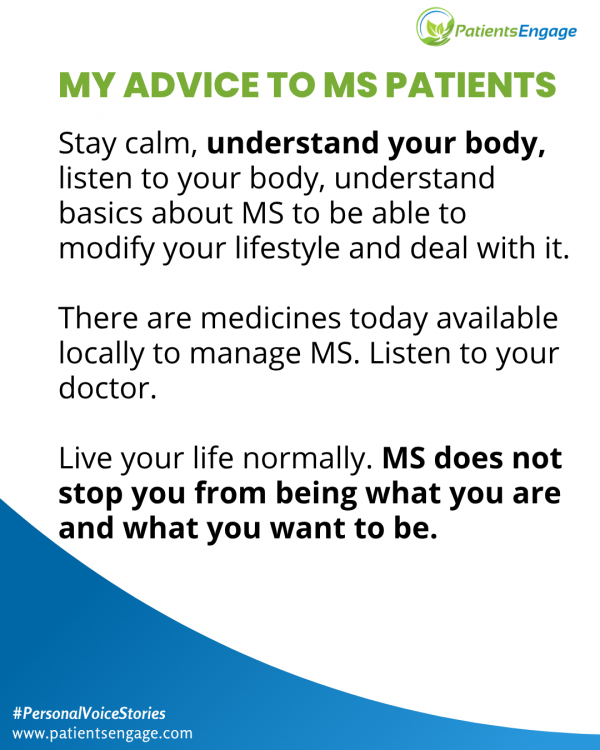
Stay calm, understand your body, listen to your body, understand basics about MS to be able to modify your lifestyle and deal with it. There are medicines today available locally to manage MS. Listen to your doctor alone. Live your life normally. MS does not stop you from being what you are and what you want to be.
What are you worried about for the future?
At this stage of life, actually nothing. After my diagnosis, I had asked God to give me only 9 healthy and productive so that my son could complete his education and settle. It’s been over 17 years now and I think I am living a bonus life!
*Named changed on request