

Mehul Vyas, 51, a stage 4 throat cancer survivor, talks about his regrets of consuming cigarettes and gutka which ultimately led to throat cancer and destroyed one of his vocal cords. He and his wife Anagha share their experience of dealing with cancer in a new country. He is now a passionate anti-tobacco advocate who talks to children in schools on the ills and dangers of tobacco consumption.
Please tell us a bit about your condition.
Stage 4 laryngeal cancer in my right vocal cord.
What were the early symptoms? How did the diagnosis come about?
I had been smoking cigarettes since college days, mostly due to peer pressure from friends. My cancer is due to my tobacco use. We had a small travel business and my drivers used to have gutka, so I too had started eating gutka with them.
After I started working at a Call center, the smoking and drinking continued. I always thought I would quit when one of my friends who consumed more than me would get cancer.
In 2014, I noticed I had some changes in my voice along with weight loss, and difficulty breathing. I went to my local doctor few times, who never did any detailed investigating, put me on antibiotics. Then my mother took me to a hospital where they did an endoscopy, and they suspected a tumor. They referred me to a bigger hospital for more investigations. I knew something was wrong, but could not even utter the word “cancer” at that time. Endoscopy was repeated with a biopsy and they confirmed a tumor in my right vocal cord.
What happened next? (specialist referral, course of treatment etc.)
The oncologist told me they would have to surgically remove my vocal cord. My wife had just moved to the US on a work assignment. I decided to get a second opinion in the US. They did a PET scan, which revealed that the tumor has spread to my spine and so chemotherapy will be given first to reduce the size and spread of the cancer before surgery. The chemotherapy luckily was very effective, so much so that no surgery was then needed. I was very grateful because I did not want to lose my speech.
What was your reaction to the diagnosis?
Since I was having breathing difficulty, they did a tracheostomy, and I was not able to speak. I cried a lot that week. I was alone at the hospital and I really regretted my lifestyle choices with tobacco use. When the doctors in the US told me I had a prognosis of just one month, I was determined to live.
Were there any complications from the primary condition?
The throat has constricted and once I was unable to swallow even a pill, so I was scared there was a recurrence. However, it was due to constriction and was corrected by dilating the throat. There is always a scare of recurrence, if there is ever a change in my voice or swallowing. So, I never skip my follow-ups. Even if there is a recurrence, I want it to be diagnosed as early as possible.
How did you manage nutrition?
For a whole year I had a peg tube in my stomach. I was given a diet chart and followed that. I did a lot of research online and started anti-oxidant berries. I have a smoothie jar now every day. I avoid foods with lots of artificial chemicals. I follow the 80-20 rule, which is stay on diet for 5 days of the week and can cheat on weekends. But I make sure I balance it all. Radiation and chemo changes the palate. I have a smoothie made of strawberries, raspberries, blueberries, cashews, almonds, walnuts, apple, and bananas. I make it drinkable by adding coconut water. I make six jars at a time and refrigerate them so that they last for the whole week. I have a bowl of salad mainly cucumber, carrots, green veggies and dressing for taste. Have my normal lunch and dinner avoiding processed foods. I have a cup of warm milk mixed with turmeric powder every day before bed. I started doing this AFTER I completed my treatment, so it is NOT a cure!.
What kind of specialists (including Physio/ Occupational therapist/ Psychiatrist etc.) do you consult and how often?
There was a speech therapist at the hospital. I could not talk for a year and a half. She helped me regain speech. She made me do some jaw movements and try to make different sounds at the same time. I have only one functioning vocal cord, so she helped me with swallowing techniques. I started doing yoga and the breathing exercise, chanting of the Om is helping me.
What is your advice to patients who face similar challenges?
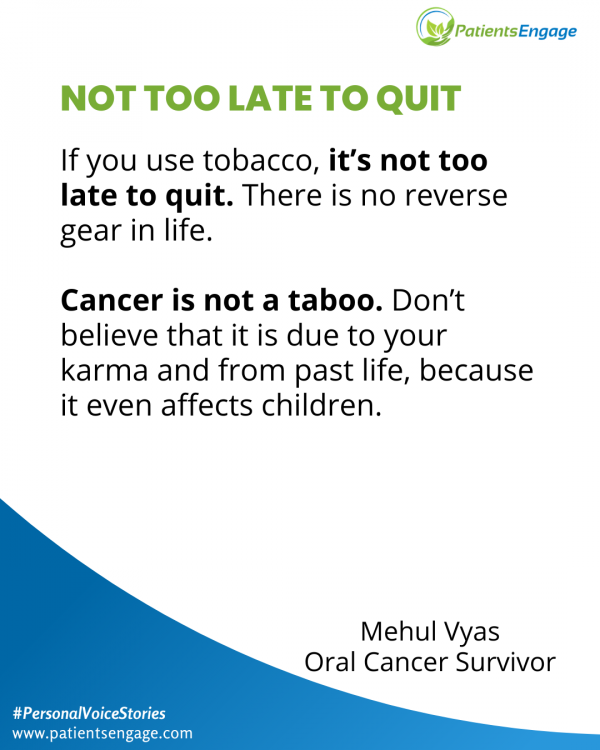
If you use tobacco, it’s not too late to quit. There is no reverse gear in life. Cancer is not a taboo. Don’t believe that it is due to your karma and from past life, because it even affects children. It is just more complicated than other diseases. Don’t follow any advice other than your doctor’s. Every person is different, if it works for my body, does not mean it will work for you. Take multiple opinions from good doctors till you are satisfied.
Have you tried complementary medicine or therapies, like homeopathy or ayurveda? If yes, did it help?
NO. I have not taken any complementary meds or therapies during my active treatment. I take ayurvedic medicine only after keeping my oncologist in loop and if they are okay with it. Cancer cannot be cured by alternative treatments. Ayurveda can be used to manage side effects, again, after your treating oncologist is okay with it.
Were there any side-effects of the medicines? If yes, how do you manage them
Yes, there were many side effects, but the treating doctors gave meds to manage them. Some of the side effects are lifelong like tinnitus, Blood Pressure, imbalance. Unfortunately, I might have to live with them.
What changes have you made to your lifestyles because of this condition?
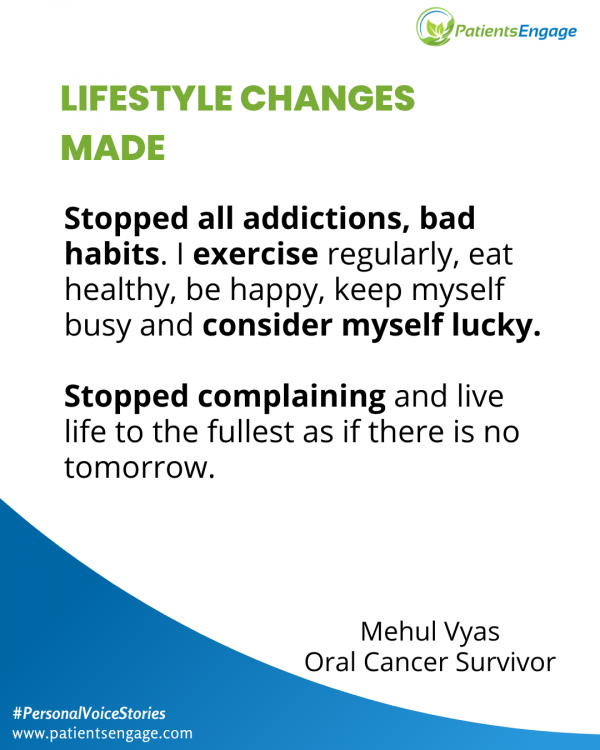
Stopped all addictions, bad habits. I exercise regularly, eat healthy, be happy, keep myself busy and consider myself lucky. Stopped complaining and live life to the fullest as if there is no tomorrow.
How did you mentally/emotionally cope with it all?
I still struggle a lot due to mental issues, but I am still working on it. Usually the fear of recurrence.
Did you see a counselor for support? Were you offered counseling by your doctor?
I was offered counselling by the doctors, but I did not opt for that. I should have.
How has your family supported you? Who has been your biggest support/companion through it all?
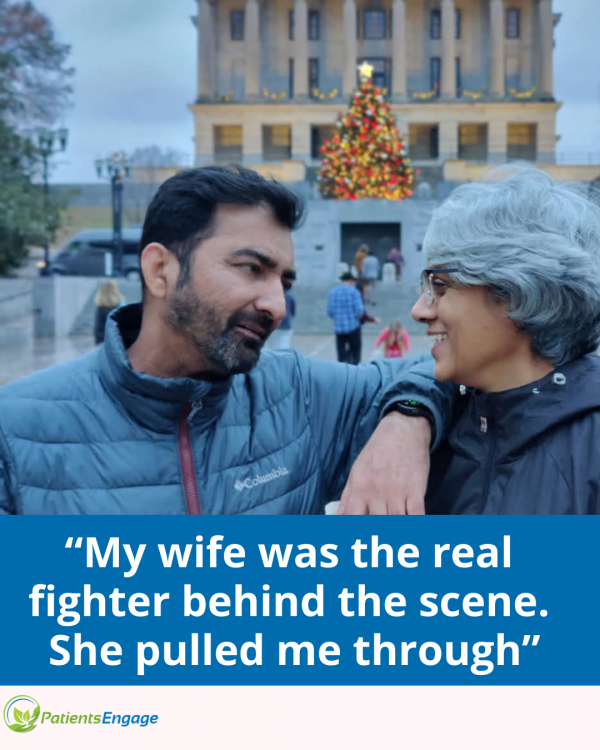
Yes, my family was of great support. My wife, Anagha, was the real fighter behind the scene. She pulled me through. My friends, specially, school friends were of great support too. They were and still are always with me.
Did you inform your workplace? If yes, how did they handle it?
At first, I did not, fearing that I might be not accepted. But later I started speaking openly and advocating coworkers on the bad effects of addiction, and how cancer can be fought.
What were some of the challenges you faced?
I still have trouble while talking as my voice is hoarse now and people find it difficult to understand some words. But I am used to it now, I try to speak slowly and make sure they understand what I am saying. My tinnitus makes it difficult me to hear at times.
What is your present condition?
At present, I am doing much better. I go for my regular follow-ups, do not miss any doctor’s visits. I spend my time with my family and try to make the most of it. Who other than a cancer survivor would know how valuable each day and life is?
Anagha, Mehul's Vyas shares her thoughts:
We took the decisions together. We took several opinions from various Oncologist connects that we had through our patients and colleague’s network. We found that the standard of care was same throughout. Once treatment started, our trust was completely with the team of doctors treating him.
You are a passionate anti-tobacco advocate. Can you share some of your efforts and your insights
As a passionate anti-tobacco advocate and a stage 4 laryngeal cancer survivor, my commitment to tobacco prevention is deeply rooted in lived experience. I’ve channeled that into founding Youngsters Against Smoking, a platform aimed at creating awareness among youth through storytelling, real-life survivor interactions, and preventive education in schools and colleges. I also serve as a founding member of the Rotary E-Club of Addiction Prevention, where we organize virtual campaigns, webinars, and collaborative events to educate communities globally.
One of the key insights I've learned: Fear can spark attention, but stories spark change. When people, especially the young, hear a survivor share what tobacco really costs, it humanizes the risk. Advocacy is most powerful when it’s personal.
I strongly believe prevention must start early, be consistent, and come from a place of empathy. Empowering people with knowledge and offering support systems is just as important as raising awareness.
What are you worried about for the future?
I am not worried about the future. What can it be worse than what I have gone through. I am thankful for all that I have.