
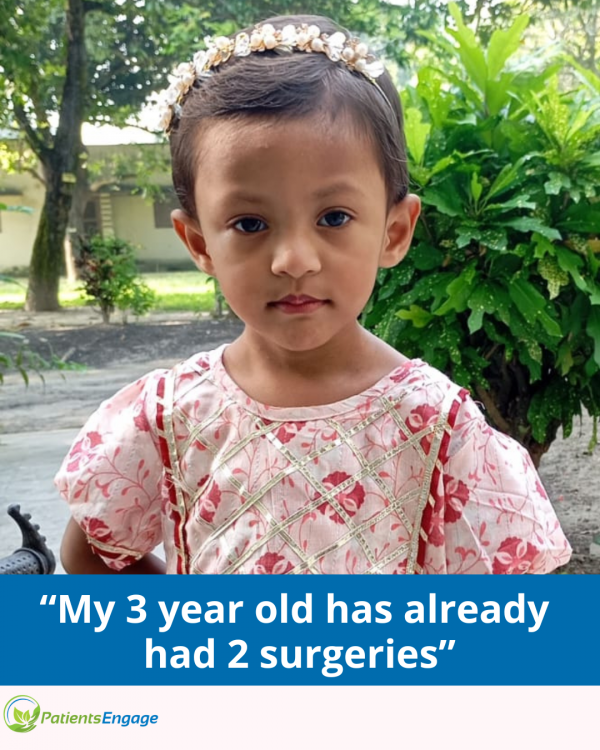
When Pritisudha’s daughter Rudranshi was born with CHD (Congenital Heart Disease), a condition with the heart’s structure which is present at birth and which can affect the normal flow of blood through the heart, her world naturally crumbled. Two successful surgeries later, 3-year-old Rudranshi is now fully recovered. She shares her journey.
At what age was your daughter diagnosed with CHD? What were the symptoms?
My daughter Rudranshi, born on 2nd January 2023, seemed a perfectly healthy baby. Interestingly, she was doing very well for the first few days. We brought her home from the nursing home on the 6th day and took her to the pediatrician for a routine check up on the 17th day. She was doing ok, except for the lack of weight gain. Still the doctor was not much concerned since all her other parameters were fine and some babies do take time to pick up weight gain. On the 20th day she started showing symptoms which we thought were normal for many babies, but were actually much more concerning. She had tremendous feeding intolerance, throwing up 90% of the feed that she was taking everytime. Her breathing was fast, she had retraction while breathing. Everyone assured me everything was fine, and that I was over reacting. But I was not satisfied. We again went back to the pediatrician, when upon a rigorous check up, he heard a 'murmur', the term that changed our world. 'Murmur' is a passive sound of the heart that comes along with the sound of the heartbeat. This signifies presence of heart issues, generally congenital heart diseases, valve function abnormalities, regurgitation and so on. The murmur gives an idea of the degree of the seriousness of the heart issue. The doctor was astounded, and had fear in his face when he heard that. We also immediately felt the graveness of the situation. I didn't know how to process it, I went numb.
We were not aware of the term then, when he used it for the first time, but that word became a part of our lives thereafter.
That was the 25th day! He referred us immediately to cardiac centers. It was on the 27th day, when we finally got her diagnosis. A large VSD (Ventricular Septal Defect) with Severe Pulmonary Artery Hypertension, Functional Single Ventricle Physiology, with the following symptoms:
- Low to minimal weight gain
- Feeding intolerance
- Retraction in breathing
- Fast Breathing.
Did you go through any pre natal screenings for congenital heart diseases? If not, why?
No, we did not go for pre natal screenings for congenital heart diseases. Reason, no one suggested, since no one suspected anything, I had a very smooth pregnancy. I was below 30, no one ever had any history of congenital defects on either side of the family, I did not have diabetes or any other pre existing condition, all my reports were not only good but perfect including the Anomaly Scan which was again done at one of the best centers. It is not that I had never heard about fetal echo cardiograph, I knew about it. But it is only suggested if there are any risk factors in the pregnancy. Otherwise it is not mandatory. It is recommended by the doctors! And hence skipped by parents to be.
Please tell us about the main challenges your daughter faces, and how do you handle those?
My daughter is 3 years old now, and in those three years, challenges never remained the same. The needs and the requirements kept changing. From 1 to 3.5 months, feeding was a constant challenge. Each feed ranged from 15 to 30 ml, whereas a normal baby drinks 150-200ml. Poor feeding resulted in poor weight gain, making her a very high risk case from the very day she was diagnosed. But that was the physical part of it. The mental load was on a different level, being rejected from every hospital for surgery, high risk case being the reason why no one wanted to operate on her. Some suggested to just let her live as long as she does without a surgery. The words kept ringing in my ears as I cradled my daughter who was too small to fight such a big war...
I collected myself, I didn't know how much time we had, but even if there was one per cent chance of a successful surgery, I was not going to give up. She did well. Things changed for the better, but newer challenges came. There was a time when her oxygen saturation fell below the 80s. And that was during the phase when the child learns and achieves milestones. With low oxygen level, our neurological as well as bodily functions slow down. While feeding has been a constant struggle, she achieved her milestones a bit late, but well within time. Each milestone has been our pillar of success and a strong validation that we never give up.
What is the medical prognosis?
She is doing well now. But will require yearly follow ups for a life time.
What kind of treatment did your daughter have to go through?
She had to go through surgical intervention. This was again not so simple or straight forward. Her case was very different and difficult. Her regular cardiologist, (the first one to diagnose) terms it as a 'miracle'.. As I have mentioned earlier, in this kind of complex heart diseases like that of a single Ventricle, normally at least 3 minimum surgeries are required. It can increase depending on many factors and in some cases there may be a need for a heart transplant as well. It is important to note that even after so many surgeries, the heart is not really cured. These surgeries are just palliative surgeries, that will keep you alive for a certain period of time, with lots of restrictions in day to day activities.
To put things in perspective, there are 2 kinds of surgeries: Correction or Palliative. With Correction, either they give you a partial or a full repair, sometimes at one go, sometimes it is a staged repair. Where Correction is not possible, at different stages they give you surgeries where you get some more time to survive. But what can actually give you a fair chance in life, is a complete correction which is difficult in our country and certainly in most of the cases.
In our case, we were told that my daughter will not survive the procedure, which involved some 3 or 4 surgeries, and in fact, most doctors refused to operate on her because of her low weight. Fortunately, one doctor did, and my daughter was out of the hospital in 7 days with her 1st procedure at 3.5 months age (Pulmonary Artery Band and PDA ligation surgeries). Then followed the long wait and the biggest challenge for her to gain weight so that she qualifies for the second surgery. Her oxygen saturation fell below 75% at times, but she never gave up. She, at such a small age, managed to stay strong and gave us the strength to go on. Then time came for yet another surgery, in 18 months, a 2nd Open Heart Surgery. Discussions about this surgery ranged from a complete correction to a palliative surgery, with most doctors suggesting palliative surgery. Only one doctor said a complete correction was possible. Our prayers were answered, and with a complete correction my daughter got her 4 chambered heart from a single Ventricle.
How is she responding to it?
She has responded well and has now completely recovered.
What is her follow up routine like?
Once a year check up with the cardiologist and the surgeon.
What does a typical day in your family look like for your daughter and for you?
Presently, more than anything else, we finally feel normal. Just like any other family. A typical day starts with lots of giggles, gratitude and a nice family time of any hour or so in the morning before everyone is headed to work, and my daughter to her preschool. I still choose to be a stay at home mom to look after my daughter and family. Afternoons are mostly me and her, and evenings are reserved for play, walks, chill outs, early dinner and us.
Frankly, nothing extraordinary, just a normal regular day makes us feel settled, and grateful.
Did you look for any resources/information/support regarding the condition anywhere?
We looked into research articles, medical journals, support groups on social media, real time parents enduring this journey. We looked out for not only the cardiac centers and big hospitals, we looked out for expertise, experience and teams, mostly online. We found a lot of information online.
Are you a part of any support group? Have support groups been of help?
Yes, I have been part of a few online support groups. And they have really helped us when in doubt. These groups have also been a source of constant motivation to us. Today, I am glad that by sharing my experiences I can also extend my support to others in need.
Have you shared your daughter’s condition through any social media platforms? If so, what was the reason to do so?
Yes. We shared our daughter’s condition through Facebook, as a part of Congenital Heart Diseases awareness program. The sole purpose of sharing is creating awareness for the condition and to tell everyone out there that never give up. Sometimes everything is against us, every decision, time, opinions, including zero support from people around. But if you have the will, there is a way. Giving up is easier. But standing there strong irrespective of the outcome is what makes the difference.
How have you emotionally coped with the situation? How have your friends and family supported you?
Emotionally, we were all over the place. This was a huge challenge in our lives. It was not easy to be in that turmoil. We were broken from within. Yet looking at our daughter we gathered the courage to move ahead, one day at a time. More than family, friends have supported us through our journey. They stood like pillars. Immediate family was there with us as much as they could. But it was our battle, and we stood together, my child, me and my husband.
Your advice to parents in similar situation and the change you would like to see in the healthcare system
This journey is a difficult and an unpredictable one, and there will be challenges at every corner. No sooner have you negotiated one crisis, another one is ready to hit you. But don’t give up.
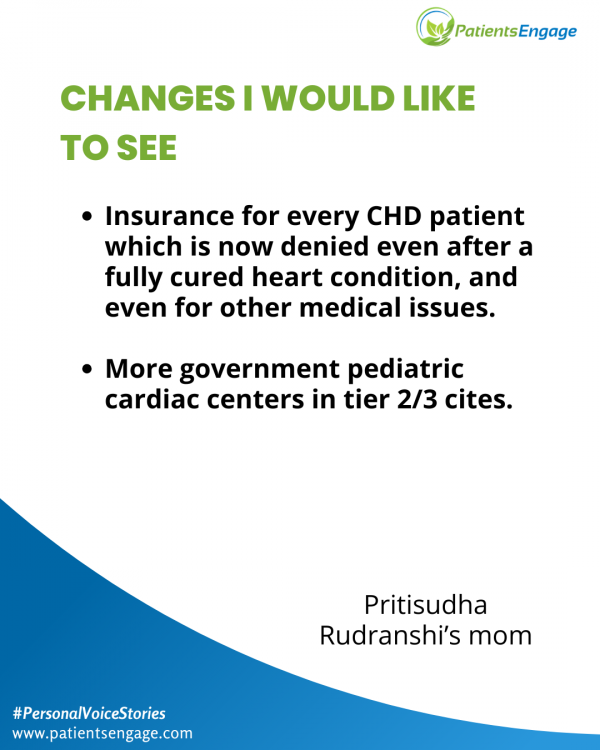
One change I would really like to see in the medical healthcare system, and this is very important, is insurance for every CHD patient which is now denied even after a fully cured heart condition, and even for other medical issues. Secondly, more government setups for pediatric cardiac centers in tier 2/3 cites.
As told to Moyna Sen