
Living with a rare disease presents itself with many challenges. Some are common across the rare diseases, but others are unique. Read on to find out what some of our contributors who are persons with lived experience of rare disease had to say on the theme and the challenges.
The term “rare disease” means nothing to large parts of the population who have no experience with rare disease. However, the moment someone is diagnosed with a rare disease, the perception sees a sea shift. It brings to mind challenging scenarios and fat medical bills.
The theme for Rare Disease Awareness Month this year: More Than We Can Imagine.
This emphasises that there are:
- More people living with a rare disease than we can imagine: Approximately 300 million or 30 crores.
- More rare diseases than we can imagine: There are about 7,000 rare diseases that have been identified by researchers so far.
- More challenges in living with a rare disease than we can imagine.
- More support that persons living with rare diseases need than we can imagine.
Read on to find out what some of our contributors who are persons with lived experience of rare disease had to say on the theme and the challenges.
Ashwini Nalhe | Scleroderma, Myasthenia Gravis
One fact I wish people understood:
I have been living with rare autoimmune diseases since 2011.
Fourteen years of watching my own body slowly turn against me.
I live with Systemic Sclerosis, Interstitial Lung Disease, and Myasthenia Gravis. They are called “rare.” But there is nothing rare about waking up every morning unsure of how strong your muscles will feel, how clear your mind will be, or how cooperative your lungs will remain.
Autoimmune disease is betrayal from within. It does not announce itself loudly. It erodes quietly. It scars lungs, weakens muscles, clouds memory, tightens skin, and steals energy in ways that are invisible to the world.
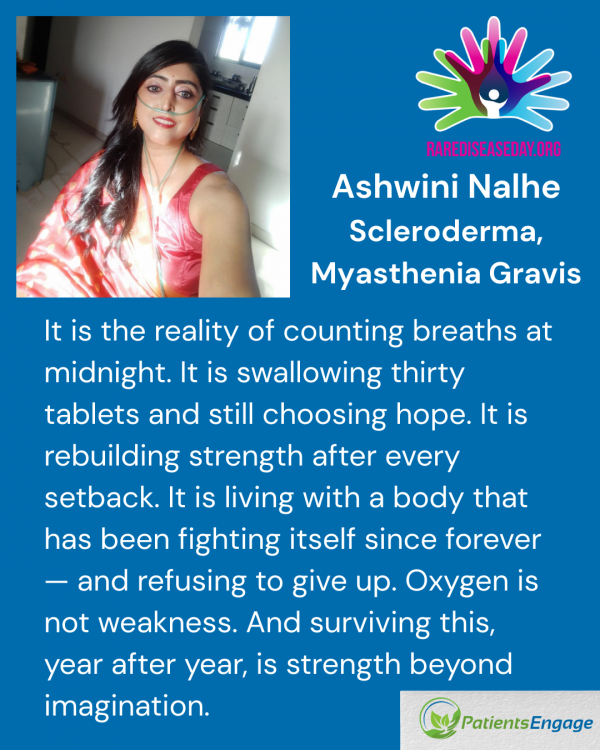
For the past four years, I have depended on oxygen support, and at night, I use a BiPAP machine with supplemental oxygen to help me breathe. Oxygen is not a temporary support. It hums beside me at night. It travels with me. It dictates how far I can go and how long I can stay. It is my lifeline — something most people never think about, but something I must constantly protect.
I take more than thirty tablets every single day. My life is measured in dosage schedules, pulmonary tests, hospital admissions, discharge summaries, and recovery periods that never fully restore what was lost. And yet, I am often told, “You look fine.”
What people do not see is the fatigue that sleep does not cure. They do not see the brain fog in the middle of conversations. They do not see muscle weakness turning ordinary tasks into mountains. They do not see the fear that accompanies every infection. They do not see the emotional toll of cancelled plans and postponed dreams.
The one fact I want people to understand is this: Rare disease is a full-time battle fought in a body that appears ordinary.
The Challenges That Must Be Prioritised:
- Affordable, Lifelong Treatment and Oxygen Support
Chronic illness is not a one-time expense. It is continuous.
Oxygen concentrators must be purchased and maintained. They operate continuously, which increases electricity bills. Repairs are costly. Portable concentrators are expensive and often last for a few years, adding to the financial burden. There must always be backup during power cuts. Immunosuppressants are not optional — missing doses have consequences. Regular scans, specialist consultations, and emergency hospitalisations form a cycle that never truly ends.
Financial anxiety becomes layered over physical suffering. Every hospital admission carries not only medical fear, but economic uncertainty.
Breathing should not depend on financial strength. Survival should not feel like a privilege.Sustained financial protection for rare disease patients — especially those dependent on long-term oxygen — is not charity. It is dignity.
- Social and Workplace Stigma — The Need for True Inclusion
The second challenge is less visible but equally painful: misunderstanding.
When you “look fine,” your suffering is minimised. Fatigue is mistaken for laziness. Brain fog is misunderstood as distraction. Lack of oxygen can cause confusion, which may be perceived as unpreparedness or lack of confidence. Sometimes I fumble for words. Sometimes I pause longer than usual. Sometimes I seem unsure — not because I am incapable, but because my breath and clarity are not always within my control.
And when oxygen is visible, it defines you before you can define yourself.
Rare disease patients do not need sympathy. We need structural flexibility, empathy without judgment, and environments that recognise chronic illness as unpredictable but real.
Inclusion is not about inspirational stories. It is about reasonable accommodation, dignity, and the understanding that productivity can coexist with vulnerability.
The Bottom Line
“More Than You Can Imagine” is not just a theme. It is the reality of counting breaths at midnight. It is swallowing thirty tablets and still choosing hope. It is rebuilding strength after every setback. It is living with a body that has been fighting itself since forever — and refusing to give up. Rare does not mean small. Oxygen is not weakness. And surviving this, year after year, is strength beyond imagination.
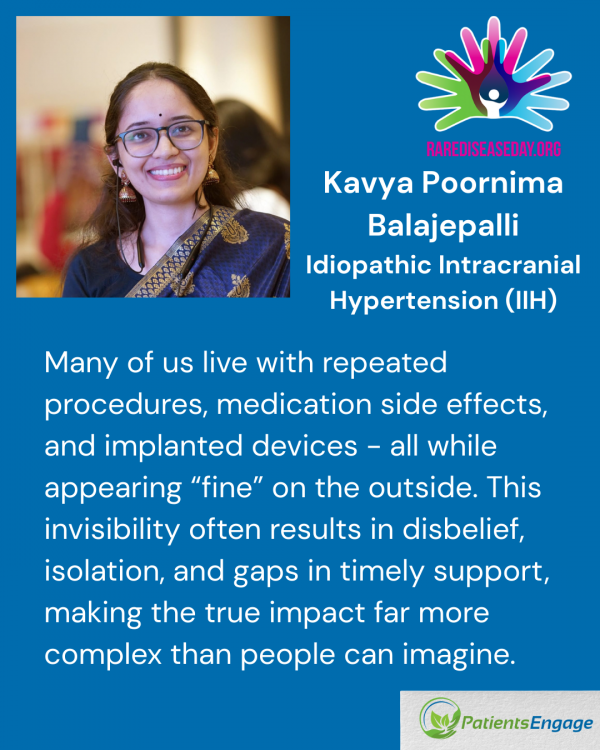
Kavya Poornima Balajepalli | Idiopathic Intracranial Hypertension (IIH)
One fact I wish people understood:
Idiopathic Intracranial Hypertension (IIH) is not “just a headache disorder.” It is a rare, chronic, and dynamic neurological condition that can lead to temporary or permanent vision and hearing loss, and lifelong disability if left untreated. IIH presents differently in each individual, is not exclusive to women, and often mimics other neurological conditions — contributing to delayed or missed diagnosis.
Managing IIH requires a multidisciplinary team, including neurologists, neurosurgeons, neuro-ophthalmologists, and primary care providers, along with continuous monitoring. Many of us live with repeated procedures, medication side effects, and implanted devices — all while appearing “fine” on the outside. This invisibility often results in disbelief, isolation, and gaps in timely support, making the true impact far more complex than people can imagine.
Two challenges that need prioritisation:
- Early and accurate diagnosis with structured rehabilitation pathways
Delayed diagnosis remains common. Strengthening awareness among primary healthcare providers, establishing clear referral systems, and integrating rehabilitation early can prevent irreversible damage and reduce long-term disability-adjusted life years. Rehabilitation also supports adaptive learning, enabling individuals to navigate all facets of life with greater independence and dignity.
- Universally accessible infrastructure and long-term systemic support
Medical treatment alone is not enough. We need universally accessible physical, digital, and healthcare environments, reasonable accommodation in education and employment, universal health coverage with strong financial protection mechanisms, disability recognition, and integrated mental health services. As these conditions are lifelong, policies must safeguard sustained quality of life across the life course.
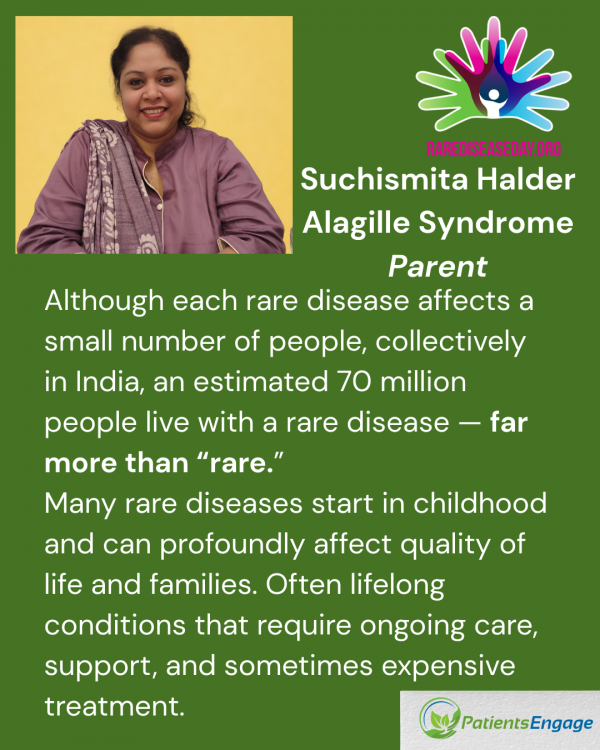
Suchismita Halder, mother to Ethan | Alagille Syndrome
One fact I wish people understood:
Although each rare disease affects only a small number of people, collectively they affect millions. In India alone an estimated ~70 million people live with a rare disease — far more than “rare.”
Rare diseases are often lifelong conditions that require ongoing care, support, and sometimes expensive treatment. Many rare diseases start in childhood and can profoundly affect quality of life and families.
Two challenges that need prioritisation:
- Timely and accurate diagnosis - Delays in diagnosis lead to preventable complications, emotional distress, and loss of critical treatment windows. This can only be addressed through greater awareness and training, both among healthcare professionals and patients/caregivers, so early warning signs are recognised and acted upon.
- Access to inclusive, multidisciplinary care - Rare diseases often affect multiple organs and require coordinated care across specialties. An inclusive medical system, where specialists, allied health professionals, patients, and caregivers work together is essential for lifelong management, continuity of care, and improved quality of life. Rare diseases are chronic. Families need sustained support for medicines, procedures, nutrition, devices, therapies, and travel — not one-time assistance. Also, mental health care must be integrated into rare disease management.
Shilpi Bhattacharya | GNE Myopathy
One fact I wish people understood:
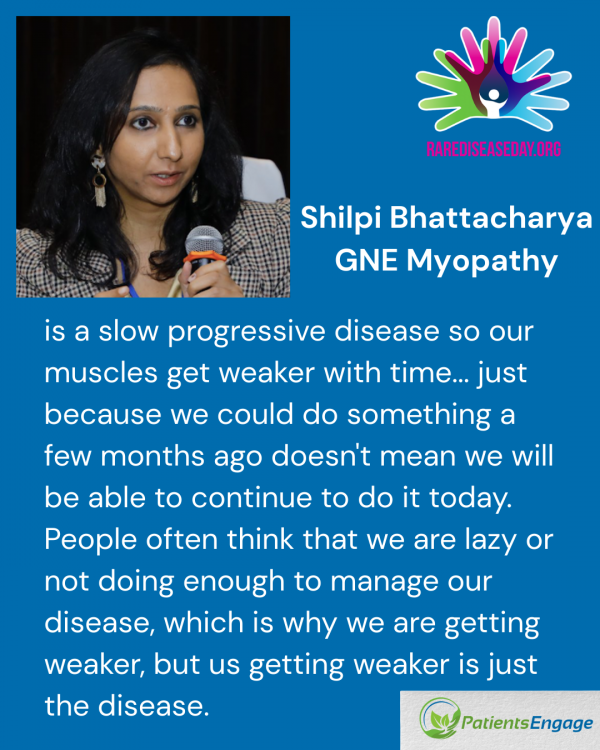
GNE myopathy is a slowly progressive disease so our muscles get weaker with time, this means that just because we could do something a few months ago doesn't mean we will be able to continue to do it today. People often think that we are lazy or not doing enough to manage our disease, which is why we are getting weaker, but us getting weaker is just the disease.
Two challenges that need prioritisation:
- Accessibility of all spaces - and that doesn't simply mean having ramps but keeping the needs of people with disabilities in mind in the design of spaces e.g. simple things like heavy doors or slippery surfaces or low toilet seats can make it difficult for us to access spaces with dignity.
- Treatments and research - most rare diseases like GNE myopathy have no treatments and pharma companies are not interested in investing in these diseases. These diseases are not even mentioned in the Indian rare disease policy. Governments need to actively work towards pushing scientific research to understand rare diseases, build patient registries, encourage translational research and development of platform therapies or other treatments for rare diseases. Without the government's active involvement, these diseases will remain marginalised.
Shruti Gupta, Mother to Ishika | LAMA 2 Muscular Dystrophy
One fact I wish people understood:
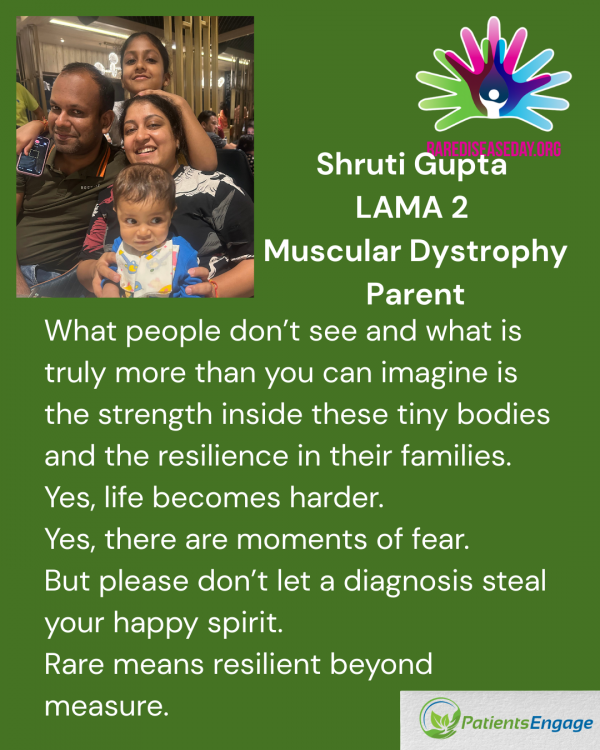
My beloved 2-year-old daughter Ishika lives with an ultra-rare genetic disorder called LAMA2 Muscular Dystrophy.
What people don’t see and what is truly more than you can imagine is the strength inside these tiny bodies and the resilience in their families.
Yes, life becomes harder.
Yes, there are moments of fear.
But please don’t let a diagnosis steal your happy spirit.
We all have 1000 reasons to cry and lose hope.
Yet sometimes, it takes just one reason to smile to survive and even thrive though the probability feels like 0.00001.
Rare doesn’t mean weak. Rare means resilient beyond measure.
What are the two challenges that you would like prioritised?
- Finding and uniting LAMA2 patients in India under Lama2 India, a registered trust
Ultra-rare conditions are isolating. Families feel alone.
Our first mission has been simple but powerful — find each other.
So far, we have identified 100+ LAMA2 patients across India.
But many families are still undiagnosed, unheard, and unconnected.
Community is not emotional luxury. It is survival infrastructure.
- Kickstarting human clinical trials for LAMA2
Awareness is important. Data is critical.
But clinical trials are essential.
Without structured research and human trials, hope remains a conversation and not a solution.
India has the talent, the patients, and the scientific ecosystem.
What we need is urgency, collaboration, and commitment.
BharathMD Foundation | Duchenne Muscular Dystrophy
What is the one fact about your condition and the persons affected that you would like people to know about?
One fact about Duchenne Muscular Dystrophy (DMD) in India that people should know is that it’s a rapidly progressive, fatal muscle-wasting disorder, yet most people — including many doctors — aren’t aware of how quickly it weakens muscles, including the heart and lungs, often leading to late diagnosis and missed chances for care.
What are the two challenges that you would like prioritised?
The challenges mostly faced by DMD community are
- Access to Affordable treatment and Assistive devices
Access to affordable treatments and affordable devices is a significant challenge for DMD patients in India due to:
- High treatment costs: Gene therapies and corticosteroids, crucial for DMD management, are expensive (₹5 crore to ₹26 crore per patient), making them inaccessible to most families.
- High Cost for Customized Assistive devices: Wheelchairs (manual & powered), BiPAP and its accessories, Home Modifications, Ramps, Orthotic supports, etc.
- Limited or No Insurance coverage: Many insurance plans don't cover DMD treatments. Even basic care like physiotherapy, steroids, and assistive devices can be expensive and not covered by insurance.
- Lack of government subsidies: Limited government support for rare diseases exacerbates affordability issues.
- Need for multidisciplinary care: DMD requires ongoing physical therapy, respiratory support, and cardiac care, adding to costs including consultation, blood work, and tests like 2D ECHO, PFT, and sleep studies.
- Improved awareness and management
- Lack of awareness: Many healthcare providers are not familiar with DMD symptoms, leading to delayed diagnosis. Schools often don’t understand the needs of affected kids, making inclusion tough.
- No standard care protocols: India lacks widely followed guidelines, leading to fragmented treatment across neurology, physiotherapy, cardiology, and respiratory care.
- Limited access to specialists: Neuromuscular specialists are few and mostly in big cities, making follow-ups hard for rural families.
- Psychosocial impact: Families struggle emotionally and financially, with little counseling or support available.