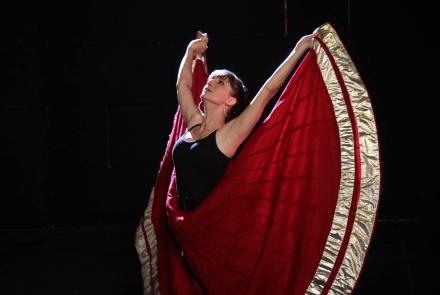
Restoring self-esteem and self-worth is what Dance Movement Therapy by Renelle Snelleksz has successfully achieved for a cross section of people like people with Parkinson’s Disease or those with a history of physical abuse and even children who have survived cancer but are deeply scarred.
What is Dance Movement Therapy? How is it different from learning Dance?
Dance Movement Therapy (DMT) is very different from technique-based dance in that it creates a safe and non-judgemental space for…

Prajakta Paranjpe, 47, a Singapore resident, was diagnosed with ovarian cancer, with almost no symptoms. A surgery and six rounds of chemo later, she has been clear for a year, and has even gone trekking to the Himalayas. Read how she navigated her recovery process.
Today, I am totally fit and healthy. I am working full time and trekking on the weekends. In fact, I believe I am a lot healthier now than I was 5-7 years ago. At present, there is no evidence of cancer in my body. My last chemo was in Nov 2024, and in Nov 2025 I was trekking in the Himalayas, near Mt. Everest.
What were the early symptoms of ovarian cancer? What made you go to a doctor?
My cancer discovery was accidental and by sheer good luck. There were no significant symptoms except for basic acidity or constipation related complaints. Nothing major, and I was taking home based ayurvedic medicines for these minor issues.
When and how were you diagnosed? What tests were done? How did the diagnosis come about?
In my annual check up every year, I also test Tumor Markers over and above the standard lipid profile, Vitamin D, etc. In my Jan 2024 check up, my Ovarian cancer tumor marker, CA 125, which was my initial test, was borderline. The doctors advised me to go for a scan and recheck blood report after a month. However, I went off on a 3 month business trip without checking, because I was feeling totally healthy and cancer was not even in my dreams. In fact I was preparing for a long distance trek to the Himalayas. This was a 68 kms trek over 7 days, with a maximum altitude of 11,930 ft. It was overall a moderate difficulty level trek.
Upon return after 3 months, I followed up with the blood test, where the tumor marker had shot up significantly. This led to further testing.
What happened next?
I had just returned from the gym, when my doctor called me to ask why I skipped the MRI appointment. And then she told me about the following blood tests and explained why urgent MRI was necessary. Upon hearing this, I lost all my energy and had to sit down. On one hand there was complete disbelief - one minute, I was doing strength training in the gym for 1 hour very easily, and the next minute, I was hearing about my blood test results indicating cancer. How was that possible? My husband saw the report and found it tough to believe (so did I). But we went ahead with the tests and MRI anyway.
What was the diagnosis after MRI? Was there an ultrasound as well? What type of ovarian cancer was diagnosed? Any lymph node involvement?
MRI showed that the tumor was attached to the left colon. There was a risk of colon resection during surgery. Thankfully, that did not happen in the end and the surgeons were able to scrape off the tumor without cutting the colon. Some lymph nodes in the pelvic region looked swollen in the MRI. I ended up losing 4 on each side during surgery. Biopsy showed lymph nodes were not infected. Before the MRI, I had also done a CT scan of the abdomen, thorax and pelvic area to see if there were other tumors in the region. The result was all clear. After the MRI, I also did an endoscopy and colonoscopy to assess if the tumor started inside the colon (as it was stuck to the colon from the outside). This report was also all clear.
What kind of surgery was it? Was any of the organs removed? If yes, did it result in early menopause?
I had an ovarian cancer surgery that was successful in removing both tumors. Two ovaries had one tumor each. This was a total hysterectomy and oophorectomy (removing uterus, ovaries, fallopian tubes). This resulted in forced menopause. I also lost some lymph nodes. Thankfully the cancer did not spread anywhere.
What happened next? (specialist referral, course of treatment etc.)
Unfortunately 4 weeks after that the surgery had an infection and had to be hospitalised again and go through a minor procedure. That was highly stressful. Immediately after that, I started chemo, for 6 cycles. My last cycle ended in early December. I did not need radiation treatment.
What was your reaction to the diagnosis? How and when did you break it to your family?
I had not informed my 14 year old son and 79 year old father about this until surgery. They were thinking this was a normal hysterectomy, which many women my age have to go through. After the surgery when the doctor told me this was stage 2 ovarian cancer and that I was lucky this was diagnosed relatively early, we broke the news to them saying the surgery was not a normal hysterectomy but a cancer surgery and that I will be going through Chemo. They were obviously shocked and worried, but I could also inform them that all tumors were already taken out so this is more like preventive chemo.
Did you have pre-existing health conditions?
I had some conditions which I thought were due to ageing and happen to people after 40. Little did I know they were signs of ovarian cancer.
- I had recurring acidity and constipation issues.
- I would feel tired relatively easily (even though I was regular at exercising). Even after a good night’s sleep I would not feel well rested the next morning.
- My immunity seemed to be low in the last few months before diagnosis. I got sick too often. Just weak but somehow wasn’t sure what had happened.
- I was going through a lot of mental stress for a very long period of time (almost 2-3 years before this)
In the past I also had eczema, which is not connected to ovarian cancer.
What cancer treatment are you on now?
Nothing.
How did you manage the effects of forced menopause?
In an unexpected turn of events, meditation helped me a LOT to overcome menopause problems. E.g. my hot flashes reduced. My sudden fear and sleep problems got resolved. Recently I also took some ayurvedic medicine for improving digestion, and that also helped. However, I continued to have UTI’s which sometimes happens after menopause. To manage that the doctor gave me a month’s HRT (Hormone Replacement Therapy). I am about to end the HRT course, and I feel relaxed. I’ve not had UTI or related issues in the last few days. Hope this continues.
What is your treatment pattern? Besides medication, what else do you do to heal and improve quality of life (diet, nutrition, exercise)?
I did multiple things and focused 100% of my time on healing my mind and body.
During the healing process, I practised:
- Pranic healing, Meditation for peace and Mental healing exercises to release past frustrations, stress and anger
- Strict diet - I created my own plan. I had boiled vegetable soup everyday. Vegetable soup / juice is easy for digestion, and I found comfort and strength in it.
- Sitting in the sun every day for at least 30 minutes.
After chemo, for regaining strength, I did the following:
- Yoga
- Mild, home based strength training using body weight
- Worked with a Naturopathy doctor to get medications for recovery after chemo and surgery (probiotics, detoxification, resolving diet issues)
- Continued with meditation
- With all this I gained natural strength and started trekking, which is an additional exercise.
What is your follow up routine, as per your treatment?
I do a blood test once in 3 months. I’m due for a CT scan soon.
Have you had to make some changes to your lifestyle because of your condition?
I now have a significantly improved lifestyle compared to what I had before cancer. Limited screen consumption, happy thoughts, sleeping on time, spending time outdoors and in nature, regular exercise, controlled diet, regular meditation and affirmations practice, and everything that one can think of.
Did you continue working through the treatment? Did you resume work after treatment?
I could not work immediately, there was not enough energy. My surgery was in June 2024, and I joined back my work from June 2025.
Did you get an ok from your doctor before your trek?
I didn't really ask the doctor about the trek. Because by then I was fine and not seeing any doctor. I practiced for a trek like a normal person, tested my stamina as per norm, and went ahead. I just informed my oncologist upon return, when I went to see her next.
What are your main challenges and what is your advice to patients who face similar challenges?
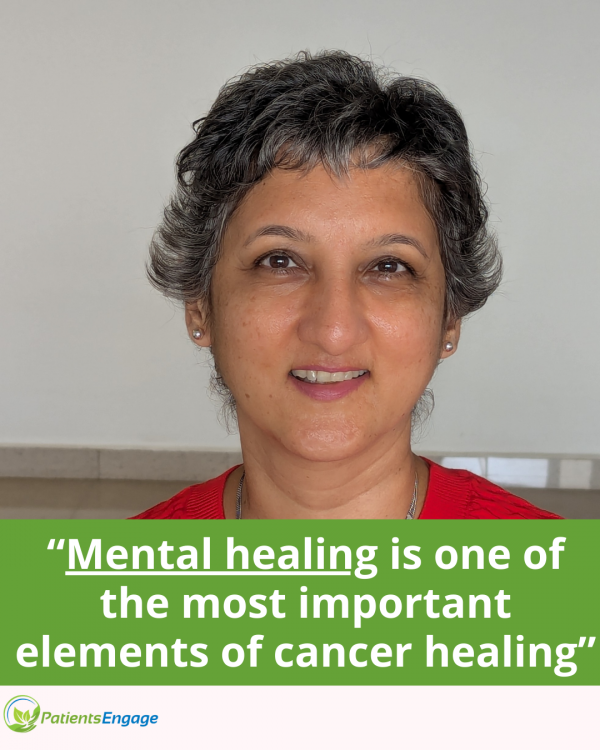
Mental healing is one of the most important elements of cancer healing.
What kind of specialists do you consult (including Physio/ Occupational therapist/ Psychiatrist etc.) and how often?
Currently I am not consulting anyone.
Do you have a family history of this condition? Was genetic testing done?
My mother passed away due to stomach cancer. However, I did proper genetic testing, and the test was negative. I don’t have any genetic issues.
Has it been difficult emotionally to cope with your condition?
Initially, this was a major shock. I just couldn’t understand how someone who is a health and gym enthusiast like me could get cancer. I was devastated.
But during this period I got to learn a lot about health, age old practices, modern medicine and processes. This knowledge helped me improve my habits as well as my family’s health and as of today, I am grateful that I got a chance to go through this journey. It was really tough, but it has also given me a lot of useful knowledge in life.
How has your family supported you?
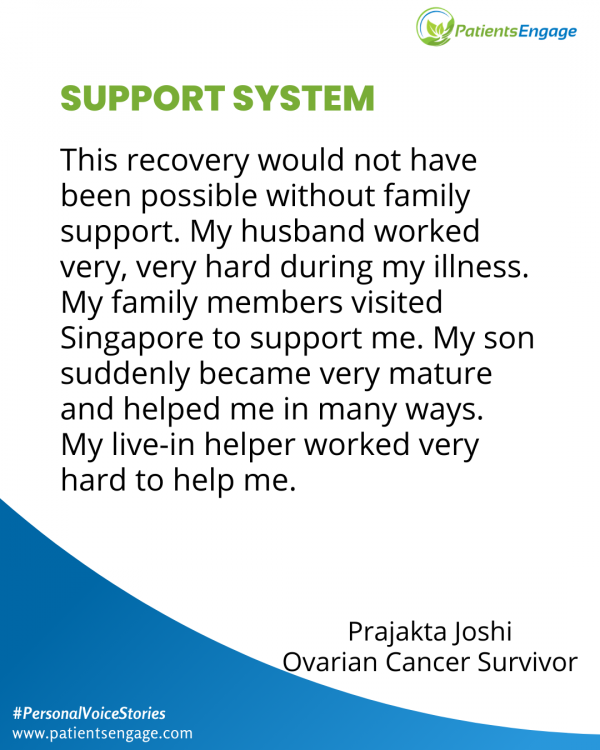
This recovery would not have been possible without family support. My husband worked very, very hard during my illness. I regularly had family members visit Singapore from India to support me. My son suddenly became very mature and helped me in many ways.
I have a live-in helper who also worked very hard to help my condition.
God has blessed me with a wonderful support system.
When did you break the news to your friends and distant relatives? How did they take it?
I live in Singapore and all my relatives are in India.
To my Singapore based friends, I told them a few days before surgery. And they were all shocked of course. Many did not know how to speak with me, and others were very comfortable in extending a supporting hand.
I told my relatives in India after the surgery was done. By this time I knew what stage it was in, and I was confident that I would be able to overcome this. They were all shocked, and were surprised to see how relaxed I was about this whole episode (because by then I had recovered from the nervousness and had moved on to recovery).
Any personal anecdote you’d like to share with us.
While I never ever wanted to go through cancer, this disease gave me the opportunity to do something incredible - I went from chemotherapy in Nov 2024 to trekking in the Himalayas in Nov 2025. This has been possible because of the detailed wellness plan which I created for myself through research, support received from family and talented doctors, and blessing from God.
This was also possible because of the health knowledge I gained during this period, and now I think it’s my turn to share this with others.
What are you worried about for the future?
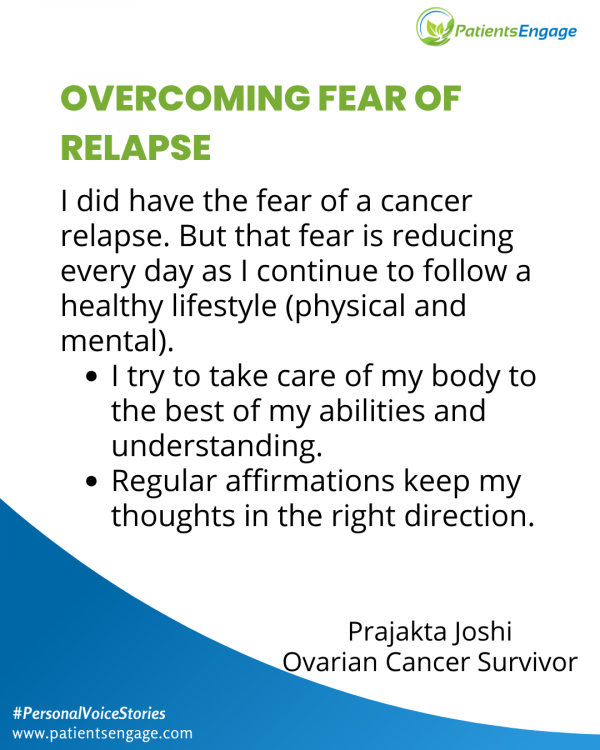
I did have the fear of a cancer relapse. But that fear is reducing every day as I continue to follow a really healthy lifestyle (physical and mental). There are 2 key aspects in getting over this fear:
- I try to take care of my body to the best of my abilities and understanding.
Regular affirmations to keep my thoughts in the right direction.
Changed
16/Feb/2026
Community
Condition