
Submitted by PatientsEngage on 22 July 2018
Stock image of a woman in a white shirt celebrating in a green field with a new look with a scarf to address hair loss during chemotherapy

Rebecca D'Souza, clinical psychologist with Nag Foundation, an NGO in Pune working for the welfare of cancer patients, says losing hair due to chemotherapy is one of the biggest fears for women, and suggests ways of dealing with the stress and emotions.

Cancer is a much maligned and dreaded disease partly because of the lack of awareness and partly because of our understanding of the disease and its treatment. Lack of awareness is one of the main reasons for late diagnosis and a lack of understanding of its treatment contributes to increased psychosocial distress.

The Big Fears of Cancer

If you list the fears patients have, on the top of the list is Acceptance of the diagnosis followed by fear of treatment. Acceptance comes because as one of the patients shared ‘everything happened so fast I had no time to think’ or as another shared “I had no choice I wanted to live and acceptance is half the problem solved”.

The next fear is more difficult to face, because it not only changes your appearance, but also is a constant reminder that you are facing the big ‘C’. And is one of the major reasons for refusal of treatment and /or social withdrawal or isolation. It’s a major challenge for most women.

Hair loss is one of the side effects of chemotherapy and often the most devastating one for women. It affects self-esteem and self-confidence.

Coping with hair loss

So how do women face this dread? As you talk to women patients and listen to their stories, you hear the pain, the shame, the guilt, the self pity but you also hear the grit, the determination, the resolve and the acceptance.

From crying uncontrollably, to refusing to look at oneself in the mirror, to donating it as an offering, isolating themselves from friends and family, to making bold statements, it’s a long journey that starts in tears but most often ends in confidence.

The stigma of cancer comes from innocuous statements made by well meaning friends and family, the look of pity, the long silences, advice for just about anything from treatment options, diet, exercise.

What really helps is the silent support, the quiet encouragement, the listening and just being available.

Hair is considered the crowning glory of ourselves; it adds to our self worth, it gives us an identity. Most of us are always concerned about our hair; either it’s too straight or its too curly, its falling or thinning. We go through life wishing for longer, thicker, silkier hair. It makes us more feminine or more womanly.

When Mrs A was breaking down every time she saw tufts of hair in the bathroom, on the bed, on the pillow, her 18-year daughter went out and shaved her hair. Her going bald gave Mrs A the courage to go bald herself. A small gesture but went miles along.

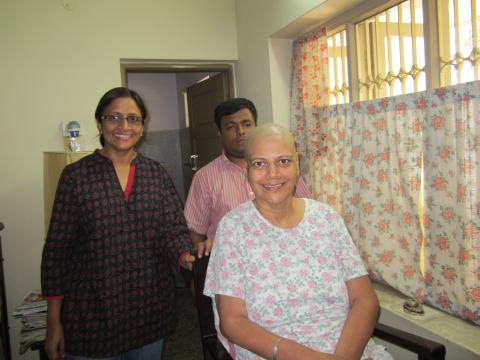
Usha Jerome's friend Jacqueline Colaco went bald in solidarity
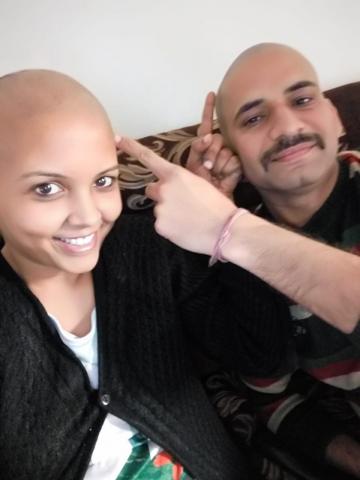
Shilpa's husband went bald to support his wife's bald look
Talking about how they feel about hair loss is important, their emotions affect the way their body heals. Expressing their pain allows for one to naming the emotions. Often patients experience a cluster of emotions from anger to guilt, from shame to sadness, talking to someone helps one sort the emotion, put it into perspective, release the tension and very often helps accept and get answers. What is important is choosing the right person to talk to. An impartial ear or a neutral person outside the situation is a good choice rather than a family member or a friend. Listening to another survivor who has been there, done that also helps new patients cope with the trauma of hair loss.

Wearing wig, scarf, hat

Wearing a wig or a stylish scarf or a hat helps women go back to into the world that they feel may not accept them or batter them with questions. Wearing a wig has made it easier for women to be accepted in the workforce, to get back to life as it was even during chemotherapy.

Saroj, Meenakshi and Shachi on scarves, hats and wigs 

The good news is that advancements in chemotherapy and inventions are making it easier for women to go through treatment.

REMEMBER

  • Talk to someone about what you are feeling
  • Consider wigs or scarves
  • Ask your doctor about scalp cooling
  • Talk to a survivor about their experience
  • Opportunity to change your appearance
  • Be patient
  • Hair grows back in most cases

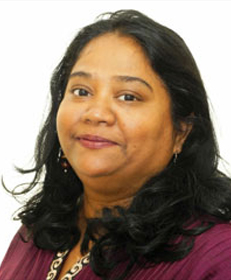
Rebecca is a clinical psychologist at Nag Foundation
 

Changed
22/Jul/2018
Community

Stories

  • Thumbnail based on world cancer day theme United by Unique and the text How Cancer Shapes Lives and Perspectives
    Cancer Turned My Life Upside Down
    On World Cancer Day, our contributors shared how cancer has changed their perspective and outlook towards life, irrespective of whether it turned their lives upside down or not.  You can also read their detailed cancer journeys by clicking on their names.  Sai Narayana Karanam, Lung Cancer How has cancer turned your life upside down? Cancer didn’t just challenge my health—it changed the way I see every single day. One moment I was living normally, and the next I was facing scans,…
  • Profile picture of a woman in a black jacket and orange shirt and the text overhead Cancer Turned My World Upside Down
    Cancer Disrupted Everything But Taught Me Power of Hope
    World Cancer Day announced the Upside Down Challenge. Anita Nanda reflects on how cancer has changed her forever. And what gives her hope and keeps her resilient. How has cancer turned your life upside down? Cancer diagnosis is a life changing event in anyone’s life. Life is totally turned upside down. The treatment is long…what’s more it is not predictable. Everyday is a new day with different experiences. Cancer turned my life upside down in ways I never imagined. Before it entered my world,…
  • Picture of the author in the hills and the text overaly I trekked the himalayas one year after Ovarian Cancer Treatment
    Mental Healing Is An Important Element Of Cancer Healing
    Prajakta Paranjpe, 47, a Singapore resident, was diagnosed with ovarian cancer, with almost no symptoms. A surgery and six rounds of chemo later, she has been clear for a year, and has even gone trekking to the Himalayas. Read how she navigated her recovery process. Today, I am totally fit and healthy. I am working full time and trekking on the weekends. In fact, I believe I am a lot healthier now than I was 5-7 years ago. At present, there is no evidence of cancer in my body. My last chemo was…
  • Stock pic of a person with a fever patch on forehead and the text overlay When to take fever seriously
    When To See a Doctor for Fever
    Fever is a common symptom. It is usually a symptom that the body is fighting an infection. However there are times, it should be taken seriously. Here the PatientsEngage team helps you understand the types and causes of fever and when to see a doctor. All of us have experienced a fever sometime in our lives. Fever is actually a good symptom as it indicates that our body is fighting an infection in our body. Our average normal body temperature is 98.6° Fahrenheit or 37° Celsius. The baseline…
  • Pic of the podcast episode Unpacking Geriatric Cancer Care with the host Aparna Mittal and the guest Dr Vanita Noronha
    बुजुर्गों में कैंसर उपचार के लिए वृद्धावस्था संबंधी विशेष मूल्यांकन का महत्व
    प्रमुख मेडिकल ऑन्कोलॉजिस्ट और शोधकर्ता डॉ. वनिता नोरोन्हा ने पेशेंट्सएंगेज पॉडकास्ट पर बुजुर्गों में कैंसर देखभाल के लिए आवश्यक विशेष वृद्धावस्था संबंधी मूल्यांकन के बारे में चर्चा की, और बताया कि ऐसे मूल्यांकन से उपचार को व्यक्तिगत बनाने में कैसे मदद मिल सकती है। जानकारी के लिए पढ़ें पॉडकास्ट पर आधारित यह लेख: जेरीऐट्रिक ऑन्कोलॉजी या जेरीऐट्रिक कैंसर केयर (बुजुर्गों के कैंसर उपचार और देखभाल के क्षेत्र) क्या हैं? जेरीऐट्रिक ऑन्कोलॉजी या जेरीऐट्रिक कैंसर केयर (बुजुर्गों के कैंसर उपचार और देखभाल…
  • Pic of the podcast episode Unpacking Geriatric Cancer Care with the host Aparna Mittal and the guest Dr Vanita Noronha
    Unpacking Geriatric Cancer Treatment in India
    Dr Vanita Noronha, a leading medical oncologist and researcher spoke on the PatientsEngage Podcast on the value of Geriatric Cancer Care and how Geriatric Assessment can help personalize treatment for older persons. What is Geriatric Oncology or Geriatric Cancer Care? Given that cancer is predominantly considered a disease of aging, why do we need a special focus on geriatric cancer care?  Geriatric means older and Geriatric oncology means Cancer in older people. There is a greater chance…
  • Poster announcing PARC Cohort 2025
    Announcing the PARC 2025 cohort!
    Are you passionate about improving access to research, fostering better care and creating a positive impact on clinical trials and guidelines for cancer? Apply to PARC (Patient Advocate Research and Clinical Guidelines) Training Program) 2025 now. What is the PARC (Patient Advocate Research and Clinical Guidelines) Training Program The National Cancer Grid and PatientsEngage are collaborating to build a team of Patient Advocates to work towards advancing patient and public involvement in…
  • A young woman, rare sarcoma rhabdomyosarcoma survivor in an outdoor setting and the text overlay I now support lung cancer patients
    A Rare Cancer Survivor Now Supports Lung Cancer Patients
    Suchismita Das was an Engineering undergraduate when the diagnosis of a rare soft tissue sarcoma (rhabdomyosarcoma, a rare cancer) in the lung, hit her like a bolt from the blue and turned her world upside down. She fought it out bravely and now she is helping others who going through lung cancer. I am Suchismita Das, 28 years old, and a rare soft tissue sarcoma survivor. My life was just like any other girl studying engineering till I started facing health issues. What were your early symptoms…
  • Stock pic of a woman's silhouette and the text Positive in the face of Gastro Intestinal Stromal Tumour
    Remaining Positive In The Face Of GIST
    Anita Sharma*, 41, is a regular, busy professional in Delhi, who was suddenly diagnosed with GIST (Gastrointestinal Stromal Tumor). She shares her experience with us. Please tell us about the condition you are dealing with I was diagnosed with GIST (Gastrointestinal Stromal Tumor). I also underwent surgery. But I’m better now after regular checkups.   GIST is a rare cancer that develops in the digestive system. GISTs arise from special cells in the GI tract wall called interstitial cells…
  • Pic of Dr Hari Menon Hematologist and Aparna Mittal and the title Unpacking CAR-T Cell Therapy Decision
    Unpacking the CAR-T Cell Therapy Decision for Blood Cancers
    In the UNPACKING podcast series, we start with a discussion on a new and exciting innovation in cancer treatment, the CAR -T Cell Therapy with Dr. Hari Menon. During the course of this conversation, we will unpack what CAR -T is, where it stands today. Is it really what you think it is and how we can take informed decisions on this new treatment? Dr. Hari Menon is Professor of Hematology and Head Medical Oncology at St. John's National Academy of Health Sciences in Bangalore. He has been in the…