Submitted by PatientsEngage on 3 April 2018
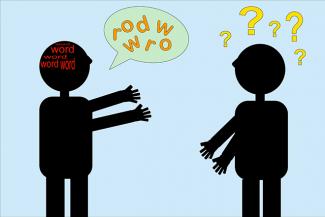
Image: Stock image of two people communicating with each other but the words in the speech bubbles are jumbled

After a stroke nearly 20-40 per cent patients develop communication problems or aphasia, the inability to comprehend and formulate language because of damage to specific language areas in the brain. Dr Sujata Gandhi, Speech Therapist, Nanavati Hospital, advises that speech and language therapy is the best way to restore normalcy and quality of life.

How does a stroke or ‘brain attack’ affect speech and communication?

A stroke causes damage to the Speech and Language areas of the brain. For most people, these are parts of the Left Hemisphere of the brain. Aphasia occurs suddenly often as a result of a stroke or head injury but may develop slowly in case of a brain tumour.

What happens when a stroke affects speech?

The difficulties of people with aphasia range from occasional trouble finding words to losing the ability to understand, speak, read or write. Intelligence, however, is not affected. Aphasia may occur with speech disorders such as Apraxia or Dysarthria.

Listen to a stroke survivor talk about her recovery from global aphasia


What is Aphasia?

Aphasia is a Communication disorder. It is the inability to comprehend and formulate language because of damage to specific language areas in the brain.

What causes Aphasia?

  1. Stroke
  2. Brain Tumours
  3. Brain Infections
  4. Head Injuries
  5. Dementia

What are the symptoms of Aphasia?

Main symptoms are:

  • Trouble to speak or slurring in speech.
  • Struggling with finding correct words or terms.
  • Using strange or inappropriate words.
  • Inability to comprehend Speech.
  • Difficulty in reading and writing.

What per cent of stroke survivors are affected by Aphasia?

According to the National Aphasia Association, 20-40% of stroke survivors have Aphasia.

Are there different types of Aphasia?

  1. Expressive / Non Fluent / Broca's Aphasia - Expression in form of speech or writing is affected.
  2. Comprehension / Fluent / Wernicke's Aphasia - Person cannot understand commands, spoken words. Their speech remains fluent. His answers will not connect to the questions.
  3. Global Aphasia - This affects all aspects of language. Both comprehension and expression are affected.
  4. Anomic Aphasia - Person has difficulty in naming objects.

How is Aphasia treated?

Speech and Language Therapy is the most essential and common treatment for Aphasia.

Can speech be recovered after a stroke?

Speech and language can be restored by Therapy. It depends on the extent of damage to the areas in the brain. Generally, therapy gives good results except in Global Aphasia where prognosis is poor.

Related Reading: Healing the mind after a Stroke

What does speech and language therapy involve?

Speech and Language Therapy involves in bridging the communication deficit. The patient needs to attend Speech Therapy sessions which may range from half hour to forty five minutes twice a week or more frequently. Regular sessions and follow up at home with the family members results in good prognosis.

What the general guidelines for communicating with people with Aphasia?

  1. Family members should understand the problem that the patience faces.
  2. Respect the patient’s age - do not treat or speak to them like a child.
  3. Do not ridicule or laugh at the errors or mistakes that they make.
  4. Speak slowly and clearly. Do not shout.
  5. Be patient and encouraging.


Dr Sujata Gandhi, Speech Therapist, Nanavati Hospital,

Changed
08/Jun/2026

Stories

  • A woman next to trees taking a picture with a mobile phone
    Don't Ignore Behavioural Changes
    Prem's startling discovery of the root cause of his wife’s altered personality. Prompt diagnosis and treatment gave him back the woman he had married.  In the summer of 2012, my wife’s behaviour started to change. Initially we attributed it to age-activated attention deficit disorder (AAADD). We noticed that she was forgetful, moving from one chore to another unmindful of the earlier one. She showed signs of indifference, depression and withdrawal.  These…
  • State-of-the-art dementia treatment facility is a 1950s era village - Hogewey
    Hogewey is an amazing "village" on the outskirts of Amsterdam. It's a step back into the 1950s boasting pretty, manicured streets, a grocery, cafe, coffee shop, restaurant and even a beauty salon and barber shop. There are 152 residents in Hogewey, and all have something in common—dementia. Hogewey is a treatment facility for dementia and Alzheimer's patients. It is set in the 1950s because the dementia patient's long term memory is preserved much more vividly than short…
  • I paint to my heart's content and refresh my mind to start each challenging day anew
    Mrs Gowri shares her experience as a caregiver of her mother with Dementia   I care for my mother, a soft natured but strong willed woman, who had worked for 35 years. Post retirement, a freak accident while gardening, which we now believe could have been caused by a mild stroke, reduced her mobility and slowly led to the degeneration of the brain cells. Normally very quiet and uncomplaining, she had begun to lose her alacrity. Without any of us being aware of the symptoms, like difficulty…
  • Still Alice: A Review from an Alzheimer’s CareGiver
    A review of "Still Alice" by Ekta Hattangady, from India who was 13 when her mother was diagnosed with Early Onset Alzheimer's at 43. Ekta became her Primary Caregiver at the age of 16. My final verdict would be…it’s a great movie. It’s not reality. Not every person with Alzheimer’s would be like this…some may be a lot worse…especially in the case of Early Onset Dementia.  Everything you saw in this movie, multiply it by 10,000 times and then you may be somewhere close to what it is like…
  • Common anticholinergic drugs like Benadryl, Nytol linked to increased dementia risk
    Nytol, Benadryl, Ditropan and Piriton among the medications identified by scientists as raising likelihood of dementia A report published online this week in JAMA Internal Medicine offers compelling evidence of a link between long-term use of anticholinergic medications like Benadryl and dementia. Anticholinergic drugs block the action of acetylcholine. This substance transmits messages in the nervous system. In the brain, acetylcholine is involved in learning and memory. In the…
  • Hope after Stroke
    An inspiring interview of Avinash Godbole who learnt to paint with his left hand, after a paralyzing stroke. Understand what he did to prevent his next stroke Symptoms of stroke are complex.  Understand the importance of acting quickly and following FAST FAST - Face, Arm, Speech, Time Is the Face uneven   Is the Arm hanging down or Leg not working as expected Is the Speech slurred Time - rush to a hospital quickly - within 4.5 hours Watch the video http://youtu.be/HjhYh1WLmIU
  • A stock pic of an elderly person being cared for
    Its ok to cry and laugh, to take time out for yourself
    This touching and poignant documentary – “Portraits of Care” –  looks at the lives of four amazing Caregivers and gives a rare glimpse into the realities of long-term care in India. A husband as caregiver, a wife as caregiver, daughters as caregivers The caregivers share the issues with home care agencies, dealing with absent and interfering relatives, caregiver stress and the financial challenges How to take time out for yourself, how to deal with your anger and frustration…
  • Old photos helping trigger memories in people with dementia
    Pictures taken by a little-known photographer between the 1930s and 1960s have found a new use helping to trigger memories and reminiscences among people with dementia. "In the dementia care world reminiscence is up there as one of the leading groups of therapeutic approaches," explains Prof Bob Woods, an expert in the clinical psychology of older people at Bangor University. "Essentially it's a good way of facilitating communication, and so it helps people to feel more socially integrated and…
  • It's called motivation and not wanting to be a victim
    Lucille Markie is a key member of the Integrated Neurological Rehabilitation Foundation in Henderson. She is calling on young people with neurological conditions to attend a series of demonstrations to see what help and support is available to them. "There are a lot of younger people like me in the community but they often don't want to attend groups because strokes can be preconceived as an older generation disability." http://www.stuff.co.nz/auckland/10539762/Stroke-won-t-slow-Lucy-down
  • A Marriage to Remember - a filmmaker explores how Alzheimer’s disease has revealed the strength of his parents’ marriage
     "The experience of caring for someone with Alzheimer's can be incredibly isolating, at a time when you need support the most. We are grateful that this process has helped us come together as a family and as a community to celebrate that most precious gift of all : our memories"   http://www.nytimes.com/2014/08/26/opinion/a-marriage-to-remember.html?emc=edit_th_20140826&nl=todaysheadlines&nlid=53809129&_r=0