Submitted by Dr S. Patel on 13 October 2016

This World Thrombosis Day, Dr Manohar B Kalbande, Cardio vascular & thoracic surgeon warns that diabetes, high cholesterol, obesity and sedentary lifestyle increase risk of Deep Vein Thrombosis (DVT) and recommends early diagnosis, complete treatment and regular follow up to get give good relief from this disease.

What is Thrombosis?

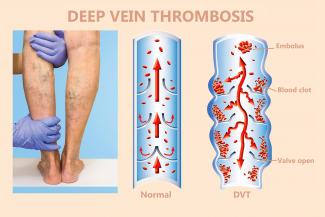
Blood returning to the heart i.e. venous blood is drained by two sets of veins in our body- superficial and deep. The deep veins are located deep in the muscles. When the blood clots in the deep veins produce obstruction to blood returning to the heart, the condition is called Deep Vein Thrombosis [DVT]. The incidence of DVT in India is much more than was previously thought as in some cases the disease goes unnoticed.

What are the signs and symptoms of thrombosis?

A bed ridden patient with DVT may not have any symptoms.

Otherwise, the person usually presents with

- swelling of limb 

- onset of acute throbbing or cramping pain of mild to moderate intensity,

- skin feels warm around the painful area

- red or darkened skin around the painful area

- swollen veins that are hard or sore 


In chronic cases, there is usually persistent leg edema, hyper pigmentation of skin with thickening is present. Advanced cases may present with large non-healing ulcers. 5-10% patients may have sudden death due to complication called Acute Pulmonary Embolism, wherein large clot from deep veins breaks up and migrates to lung arteries blocking major blood supply to lungs and causing sudden death.

What causes Deep Vein Thrombosis?

DVT occurs due to combination of three factors:

  1. Sluggish flow of blood due to various reasons
  2. Injury in the vein wall
  3. Increased thickness of blood.

Various risk factors associated with DVT are :

- increasing age,

- remaining in one position for long time as it occurs during prolonged travel,anesthesia, operation, paralysis, fracture of bones etc.

Cancer and, in females, use of oral contraceptive drugs are also associated with higher incidence of DVT. Condition called "Thrombophilia Syndrome" wherein the blood becomes thick and more prone for clotting has been recognized as very important factor.

How is DVT diagnosed?

Diagnosis of DVT is usually simple by these non-invasive tests:

-Colour Doppler Examination. It can reveal blood clots in leg veins by using sound waves to check flow in the blood veins.

-The D-dimer test which is a blood test is also done. If blood clots are present, they produce a protein called D-dimer. 

-MRI to get a more detailed image of the blood vessels in the legs and lungs.

The only invasive test used sometimes is Venography where a dye is injected into the large vein of the leg and then X-rays images are taken. This is not very commonly performed.

How is thrombosis or blood clots treated? 

The goal of treatment is to reduce the size of the clot, prevent it from travelling to the lung and reduce risk of future clots. There are  few ways to achieve these goals:

-Start with simple elevation of the affected limb in bed above heart level.

-Blood thinners or anti-coagulants are started immediately. In hospital, initially, injection of Heparin derivative Low Molecular Weight Heparin or LMWH is given for few days. An oral blood thinner then  continues for 3-6 months. Commonly these rae warfarin pills which need acute monitoring of doses by a blood test called INR.

-If regular anti-coagulants do not work, Clot-busters or Thrombolytics are prescribed. In case of a severe DVTs, the patient is given the clot-buster via a catheter under imaging which targets to break and suck the clot.

-Surgical thromboectomy or removal by operation is usually not done these days.

-Some individuals who do not tolerate anticoagulant and have clot in deep veins nearer to heart may require placing an umbrella type device called IVC Filter to prevent blood clot from breaking and causing pulmonary embolism.

-Compression stocking must be worn from foot up till the knee to prevent recurrence of clots.

Can lifestyle changes reduce my risk of life-threatening blood clots?

Diabetes mellitus, increased blood cholesterol, obesity, sedentary lifestyle increase risk of DVT. Llifestyle modification can definitely reduce the risk of the disease.

Does deep vein thrombosis increase risk for other health problems?

When not treated or inadequately treated, chronic limb swelling, dark pigmentation, eczema, recurrent ulceration etc occur called as " Post Thrombotic Syndrome" which produces morbidity and reduces functional capacity and leads to loss of working days.

What is the extent of the problem in India?

With the average rate of approximately 150 per lakh population, more than 1.5 million persons may be suffering annually in India from DVT. The disease is more common in females and occurs in lower extremities in >95% cases.

What advice would you give to help control the disease?

The message is early diagnosis, complete treatment and regular follow up can give good relief from this disease.


Changed
19/Oct/2021

Stories

  • Stock pic of a young woman fainting and the text overlay When to take fainting seriously
    आपको बेहोशी को कब गंभीरता से लेना चाहिए?
    बेहोशी एक ऐसी घटना है जिससे हम सभी परिचित हैं। यह लक्षण आमतौर पर किसी मेडिकल समस्या के कारण होता है। इस लेख में पेशेंटसएन्गेज की टीम आपको बेहोशी के कई कारणों को समझने में मदद करती है और यह भी बताती है कि डॉक्टर से कब मिलना चाहिए। बेहोशी एक स्विच के बंद होने जैसा है। इसे हम मूर्छा और चेतना खोने के नाम से भी जानते हैं। बेहोशी तब होती है जब दिमाग को कुछ समय के लिए ज़रूरत से कम खून मिलता है, और इस के कारण कुछ समय के लिए व्यक्ति अपने आस-पास की चीज़ों के प्रति अनजान हो जाते हैं। Read in English: When…
  • Thumbnail with the text What books do children and their parents read during a difficult illness World Book Day. Graphic image of a boy and a girl sitting on top of books and reading
    Books That Comforted Our Child And Us
    For World Book Day, we asked parents of children with difficult illnesses if they found reading to their children helpful or if they themselves found solace in books. Suchismita Halder, mother of Ethan who has a rare condition Alagille Syndrome and Congenital Heart Disease 1. Any book that you read out to your child during a treatment or difficult phase which was both entertainment and comfort for both of you? Ethan is not very consistent when it comes to books—he goes through phases. When he…
  • Stock pic of a Cardiac Pacemaker with text overlay on blue strip Cardiac Pacemaker FAQ
    Cardiac Pacemaker - Frequently Asked Questions
    More than 1 million permanent pacemakers (PPMs) are implanted worldwide annually. Around 100,000 devices are implanted annually in Germany, and only over 20,000 in India. PatientsEngage team answers the frequently asked questions on Pacemakers so people can make informed decisions. What is a pacemaker? A pacemaker is a small device used to correct our heart rate when it is slower than the normal heart rate (known as bradycardia). It is implanted through a surgery in the chest or abdomen from…
  • A little child flanked by her parents and the text overlay Our Daughter Had CHD. We did not give up
    We Did Not Give Up In The Congenital Heart Disease Journey
    When Pritisudha’s daughter Rudranshi was born with CHD (Congenital Heart Disease), a condition with the heart’s structure which is present at birth and which can affect the normal flow of blood through the heart, her world naturally crumbled. Two successful surgeries later, 3-year-old Rudranshi is now fully recovered. She shares her journey. At what age was your daughter diagnosed with CHD? What were the symptoms? My daughter Rudranshi, born on 2nd January 2023, seemed a perfectly healthy baby…
  • Pic of a young boy flanked by his parents in front of a camel in a desert. Text overlay Or son had his first major heart surgery at 8 months
    My Son Had His First Major Heart Surgery At 8 Months
    Vibha Dhoot, 39 from Jaipur shares the journey of her son who was born with major and multiple congenital heart defects and how the family overcame the many challenges, worked through multiple surgeries and complicated treatment protocols to give him a promising future. Please tell us about your child’s conditions and how and when this was diagnosed. At what age? How did it all start? The early symptoms. My son was born in 2016 after a full-term pregnancy. He is 9 years old now. All routine…
  • Stock pic of a young woman fainting and the text overlay When to take fainting seriously
    When Should You Take Fainting Seriously
    Unconsciousness or fainting is an occurrence that we are all familiar with. It is usually a symptom of an underlying medical issue. Here the PatientsEngage team helps you understand the many causes of fainting and when to see a doctor. Unconsciousness is like a switch turning off, and most people know this as something far more familiar called fainting. When someone faints, the brain temporarily receives less blood than it needs, leading to a brief loss of awareness to their surroundings.…
  • Stock pic of a man speaking to a doctor and the text overlay किसी भी सर्जरी से पहले डॉक्टर से क्या पूछें
    किसी भी सर्जरी से पहले डॉक्टर से क्या पूछें - 2
    सर्जरी की आवश्यकता वाली किसी स्थिति का निदान होना हममें से अधिकांश लोगों के लिए कठिन और भ्रमित करने वाली स्थिति हो सकती है। हम चाहते हैं कि सर्जरी सही समय पर, और सही प्रक्रिया से हो, पर अक्सर हमें घबराहट होती है और लगता है कि हमें जल्दबाजी में निर्णय लेना पड़ रहा है। हमें आवश्यक जानकारी की कमी महसूस होती है। इस लेख में हम 5 आम सर्जरी से संबंधित कुछ सवालों पर चर्चा कर रहे हैं, ताकि आपको कुछ जानकारी मिले और आप अपने डॉक्टर से अपनी स्थिति के अनुसार प्रश्न पूछ सकें, और आप सर्जरी संबंधित निर्णय के…
  • Stock pic of a person speaking to a doctor and the text overlay on green strip किसी भी सर्जरी से पहले डॉक्टर से क्या पूछें
    किसी भी सर्जरी से पहले डॉक्टर से क्या पूछें - भाग 1
    सर्जरी की आवश्यकता वाली किसी स्थिति का निदान होना हममें से अधिकांश लोगों को ऐसी स्थिति का पता चलना कठिन और अस्पष्ट लग सकता है।। हम चाहते हैं कि सर्जरी सही समय पर, और सही प्रक्रिया से हो, पर अक्सर हमें घबराहट होती है और लगता है कि हमें जल्दबाजी में निर्णय लेना पड़ रहा है। हमें आवश्यक जानकारी की कमी महसूस होती है। इस लेख में हम सर्जरी से संबंधित कुछ सवालों पर चर्चा कर रहे हैं, ताकि आपको कुछ जानकारी मिले और आप अपने डॉक्टर से अपनी स्थिति के अनुसार प्रश्न पूछ सकें, और आप सर्जरी संबंधित निर्णय के बारे…
  • Stock pic of a woman speaking to a doctor and the text overlay Questions to ask your doctor before a surgery
    Questions to Ask Before a Surgery – Part 2
    When one is told that they need surgery it may feel daunting and very radical to most of us. The aim is to get the surgery done on time with the best outcome and that weighs on the decision as we feel pressed for time. Here are some queries related to the 5 surgical conditions that you may ask your doctor to feel more confident about your decision and to help feel a part of the decision of going ahead with the surgery. This is the second part of the article Questions to Ask Before Any Surgery…
  • Stock pic of a person speaking to a doctor and the text overlay on blue strip Questions To Ask Your Doctor Before A Surgery
    Questions to Ask Before Any Surgery Part 1
    Being diagnosed with a condition that requires surgery can feel daunting and confusing to most of us. While we want to get the timing and procedure right, we often feel rushed into the decision for lack of information and being pressed for time. Let’s discuss a few questions pertaining to surgeries that you may ask your doctor to feel more confident about your decision and to help feel a part of the decision of going ahead with the surgery. General questions to ask your doctor before any…